4. AI and the Business Model
So far you have seen the context, the tools and the method. From this chapter on, AI becomes what it must be for a CEO: a strategic instrument that changes the relationship between costs and revenues, performance and competitiveness. This is the chapter where you start simulating, in your own head, what you would have to do in your company to ride the wave.
We start with the business model — the way your company creates value, delivers it and turns it into margin: from product to market, from marketing to competition. By the end you will know where AI intervenes in each block, what to expect in return, and one thing many CEOs underestimate: AI is not only changing how you produce and sell. It is changing the market, your customers' demand and the way your competitors compete.
The business model on one page
To reason about AI you do not need a complicated model. Six blocks are enough: who you sell to, what you promise them, how you reach and serve them, what you need to produce it (activities, resources, partners), what it costs and what it earns. AI can intervene in each, but not in the same way and not with the same return.
The rule I use to read a business model through AI's eyes is this: agents create value where there is repetitive executional work that today limits the speed, continuity or personalization of service. Where the work is relationship, judgment and responsibility, agents serve to free time for the people who do it. The business model that comes out is not "the same one with fewer people": it is a model in which promise, costs and revenues have different proportions.
| Block | Where AI intervenes | Expected effect | First results |
|---|---|---|---|
| Who you sell to | Segments and languages that were not worth serving | Revenue from new customers | 6-12 months |
| What you promise | Continuous service, personalization, response times | Differentiation, defensible price | 3-6 months |
| How you reach and serve | Lead qualification, recovery of lost sales, 24/7 support | Acquisition cost −15/30%, conversion +10/30% | 1-3 months |
| What you need | Documents, orders, reconciliations, reports | 20-40% of executional time freed | 1-2 months |
| What it costs | From fixed cost to cost per work done | Elastic capacity; variable cost with a cap | 12-24 months |
| What it earns | Decision rhythm, new revenue streams | Better operating margin from year two | 6-12 months |
The rows with results in one to three months are where you start. The rows with results in a year or two are where the structural advantage lives.
The three structural changes
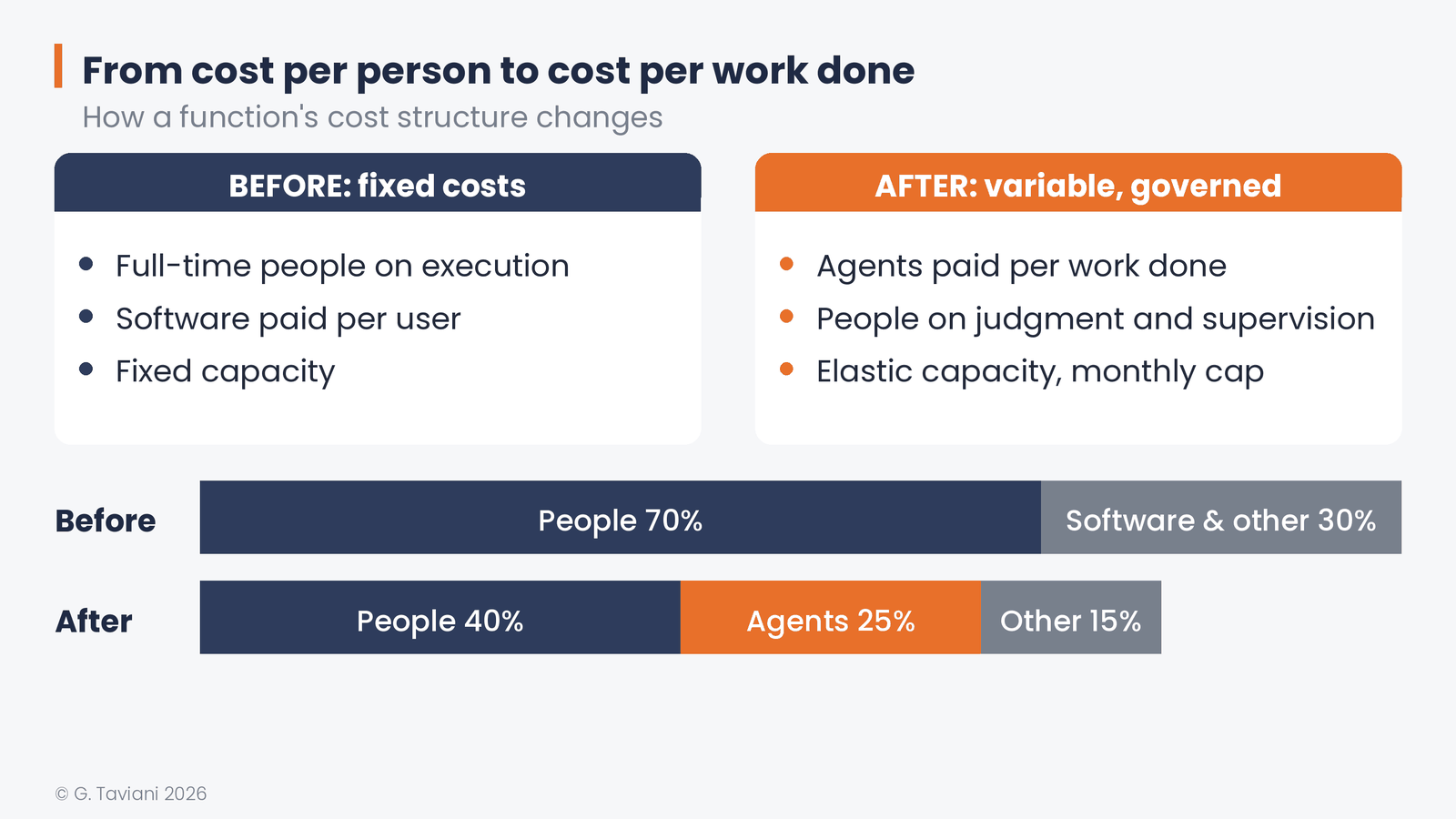
From cost per person to cost per work done
The first change is in the cost structure. For decades software was paid "per user" and work "per hour." Agents break both logics: an agent is not a user and does not work by the hour; it works toward objectives, and its cost is measured in consumption and actions. If an agent does the work of five people, the software vendor who billed five licenses now bills one: this is why 2026 marks the decline of the "per seat" model and the rise of billing units based on work done.
For your company this means that a growing share of executional work moves from fixed cost (people, licenses) to variable cost (consumption), and enters the P&L as an operating expense, not an investment. The advantage is flexibility: a seasonal peak does not require hiring; a dip does not leave idle capacity. The risk is control: a variable cost without a cap is a cost that surprises you. Every serious AI project has a monthly budget with an automatic block.
The second change is in the rhythm of decisions. A company with an AI Team can run fifty experiments a week — on prices, messages, recommendations, assortments — where it used to run five a month. Whoever has data read by agents and processes redesigned decides more often and makes fewer mistakes, because every decision is small, measured and reversible.
Rhythm is the real source of competitive advantage. McKinsey's high performers — the 6% with significant profit impact — are the ones who redesigned workflows (73% versus 25% of the others): not the ones who bought more licenses. The gap between "having AI" and "earning from AI" is entirely in the rhythm with which AI enters decisions, not in its presence.
From function to flow
The third change is organizational, but it starts in the business model. AI rewards companies organized by flows — from order to delivery, from contact to contract, from request to answer — and punishes those organized in silos. An agent that must recover a lost sale needs to read the catalog, the customer record, the warehouse and the payments; if those four data sets belong to four managers who do not talk to each other, the agent stops. Before talking about agents, then, you will talk about processes. Chapter 5 goes deeper.
Data point. Only 12% of CEOs worldwide say AI has already delivered both cost and revenue benefits; 56% see no significant financial benefit yet. Those who get both have embedded AI in products, services and strategic decisions — not just in tools — and are three times more likely to have built the foundations first: data, processes, governance. Source: PwC, 29th Global CEO Survey, 2026.
Where AI intervenes, block by block
Product and promise to the customer
The most strategic intervention — and the least practiced — is on the promise. AI lets you promise what was not economically sustainable before: an answer in two minutes at any hour, an offer personalized for every customer, a quote in an hour, delivery with proactive updates, after-sales support that anticipates the problem. Each of these promises is a point of differentiation that a competitor without agents cannot copy at the same cost.
The right way to design it is with CoS from the customer's point of view: what must be true for them for the promise to be worth the price. A components manufacturer that promises "technical quote within one working hour" is not automating the quotation office: it is changing the reason a customer chooses it.
Market and customers
The second intervention is on market access. Agents lower the cost of serving segments that were not worth it before: small customers, foreign markets with other languages, channels that require continuous presence. An SME that served only customers above a certain threshold can profitably serve those below it; one that sold domestically can handle requests in five languages without five people. The business model widens without widening the structure.
Channels, marketing and sales
The third intervention is the fastest to show results and is the subject of chapter 6: lead qualification around the clock, recovery of lost sales, personalized messaging, continuous support. Here AI acts on three numbers every CEO knows: acquisition cost, conversion rate and customer lifetime value.
Activities, resources and partners
The fourth intervention is backstage: administration, purchasing, logistics, controlling. It is the territory of the "gray" processes — data entry, reconciliations, repetitive answers, reporting — that absorb hours without adding value. Across the EU, the most common AI application among companies that use it is analyzing and extracting written information (invoices, contracts, orders). It is not glamorous, but it is where the most time is freed per dollar invested. Partners change too: an external agency that did the executional work can be replaced by an AI Team governed internally, or become the party that governs it for you.
Costs and revenues
The fifth intervention is the consequence of the first four, and it must be simulated before you start. In my experience a CEO should expect three effects, in this order. In the first 30-60 days, an effect on the cost of one process (hours freed, external costs reduced), measurable and almost always higher than the cost of the agent. In the first 3-6 months, an effect on the revenue of customer-facing functions (conversion, average order, repeat purchase). From the second year, a structural effect: a different cost structure, a service competitors do not offer, proprietary data worth more than the year before.
Watch out. The most common simulation error is counting only the labor cost saved. It is the least interesting effect and the riskiest organizationally. The larger value, in the cases I follow, sits in revenue that did not exist before: customers served who were not worth it, sales recovered, promises no competitor makes. Simulate those too, or the project will look smaller than it is.
How AI is changing the market
Demand changes before supply does
There is a part of this chapter that concerns you even if you decided to do nothing: the market is changing on its own. Your customers — consumers or companies — already use AI to choose, compare and buy, and their behavior is reshaping demand.
The US retail data is the most advanced and anticipates what is reaching every market: in May 2026, traffic to retail sites coming from AI assistants was up 138% in a year and fourteen times higher than in October 2024; visitors arriving from an AI assistant convert 54% better, stay 53% longer and view 23% more pages. Globally, Salesforce estimated that AI and agents would drive 21% of online holiday orders in 2025 — $263 billion. The customer no longer "searches": they ask an assistant to find, compare and propose. If your product, your service and your information are not readable and trustworthy for those assistants, you are simply not proposed.
B2B customers ask for more
In B2B the change is less visible but just as deep. Your business customers, if they have agents, expect counterparts at the same speed: an answer to a request for quotation in hours, not days; an order-status update without a phone call; a catalog a system can read, not only a person. Whoever cannot keep that pace drops off the preferred-supplier list before knowing it.
Competition intensifies on a new axis
AI lowers barriers: a smaller competitor with a well-governed AI Team can offer a service that used to require your structure; a foreign competitor can enter your market in your language without opening an office. At the same time AI raises barriers for late entrants: clean proprietary data and redesigned processes are assets that accumulate every day and cannot be bought. Competition intensifies on a new axis: not who has more resources, but who has more rhythm and more data read by agents.
Example. A made-to-measure furniture maker with thirty employees received quotation requests by email, answered in three to five days and converted 12%. An AI Team — one agent qualifying the request, one preparing the technical quote from price lists, one following the customer to the answer — brought response time to a few hours and conversion to 19% in four months. It did not shrink the technical office: it freed it for complex orders, the ones with the highest margin. "Quote the same day" is now in the company's sales material. (Case anonymized.)
What to take away
AI changes three things in the business model: the cost structure (from person to work done), the rhythm of decisions, and the organization by flows. It intervenes in every block, but with different returns and timing: first on internal processes and channels, then on the promise and the market, finally on the structure. And it changes the market even without you: customers choose through AI assistants, business customers demand your pace, competitors compete on data and speed.
Your to-do list.
- Draw your business model in the six blocks on one page. For each block write one sentence: "If I had a team working around the clock on this, what could I promise that I do not promise today?" The best sentences are the first CoS of your plan.
- Ask finance for the cost per work unit on your heaviest process — quotes, orders, tickets — and the share of it that is fixed.
- Set the rule now: no agent without a monthly cap and an automatic block.
Frequently asked questions
How does AI actually change my business model, not just cut a few costs?
It touches all six blocks of a standard business model — who you sell to, what you promise, how you reach and serve customers, what you need to produce it, what it costs, what it earns — but with very different returns and timing. Internal processes and channels show results in one to three months; the promise and market access take three to twelve months; a structural change to the cost base takes twelve to twenty-four months.
How much can I realistically expect to save or earn from AI in the first year?
It depends heavily on where you start: only 12% of CEOs worldwide report AI has already delivered both cost and revenue benefits, and 56% see no significant financial benefit yet. The ones who do get both embedded AI in products, services and strategic decisions rather than just tools, and were three times more likely to have built the foundations first — clean data, mapped processes, governance.
Will AI change what my customers expect from me even if I don't adopt it myself?
Yes — demand is already shifting on its own. In US retail, traffic from AI assistants was up 138% in a year as of May 2026, and visitors arriving that way convert 54% better and view 23% more pages; in B2B, customers with agents of their own expect an answer to a quote in hours, not days. If your product and company information is not readable and consistent for those assistants, you are simply not being proposed to the customer.
What's the biggest mistake companies make when estimating AI's financial return?
Counting only the labor cost saved. It is the smallest and least interesting effect, and the riskiest organizationally. The larger value usually sits in revenue that did not exist before — customers served who were not worth serving before, sales recovered, promises no competitor can match at the same cost — so a simulation limited to cost savings makes the project look far smaller than it actually is.
Sources
- Oliver Wyman, How Agentic AI Is Reshaping SaaS Valuations, April 2026.
- McKinsey, The State of AI: Global Survey 2026, 2026.
- PwC, 29th Global CEO Survey 2026, 2026.
- PwC, CEOs, to get real value from AI, put the right foundations in place, 2026.
- Eurostat, Use of artificial intelligence in enterprises, December 2025.
- Adobe Analytics via Digital Commerce 360, AI-referred traffic to retail sites doubles in a year, June 2026.
- Salesforce, With $1.25T in Holiday Sales Up for Grabs, LLMs Emerge as New Frontier for Search, 2025.
- Gartner, Roundup of agentic AI forecasts and market estimates, February 2026.
Comments & reviews
No comments yet.
Log in to leave a comment or review.