1. Riding the Wave
Anyone who lived through the previous waves — e-commerce in the late 1990s, mobile a decade later, cloud — knows that every technology wave splits companies into two groups: those who ride it and those who chase it. The difference is not budget, and it is not the technology chosen. It is the moment the person at the top decides, and the way that decision is organized.
With generative AI and agents the dynamic is the same, only compressed: what took ten years in e-commerce is taking four here. By the end of this chapter you will have decided one thing — whether your company rides or chases — and you will know what to ask before deciding anything else.
A SWOT through the CEO's eyes
I have presented this analysis to dozens of business owners. I always build it on two columns: what happens to the company that rides the wave, and what happens to the one that chases it.
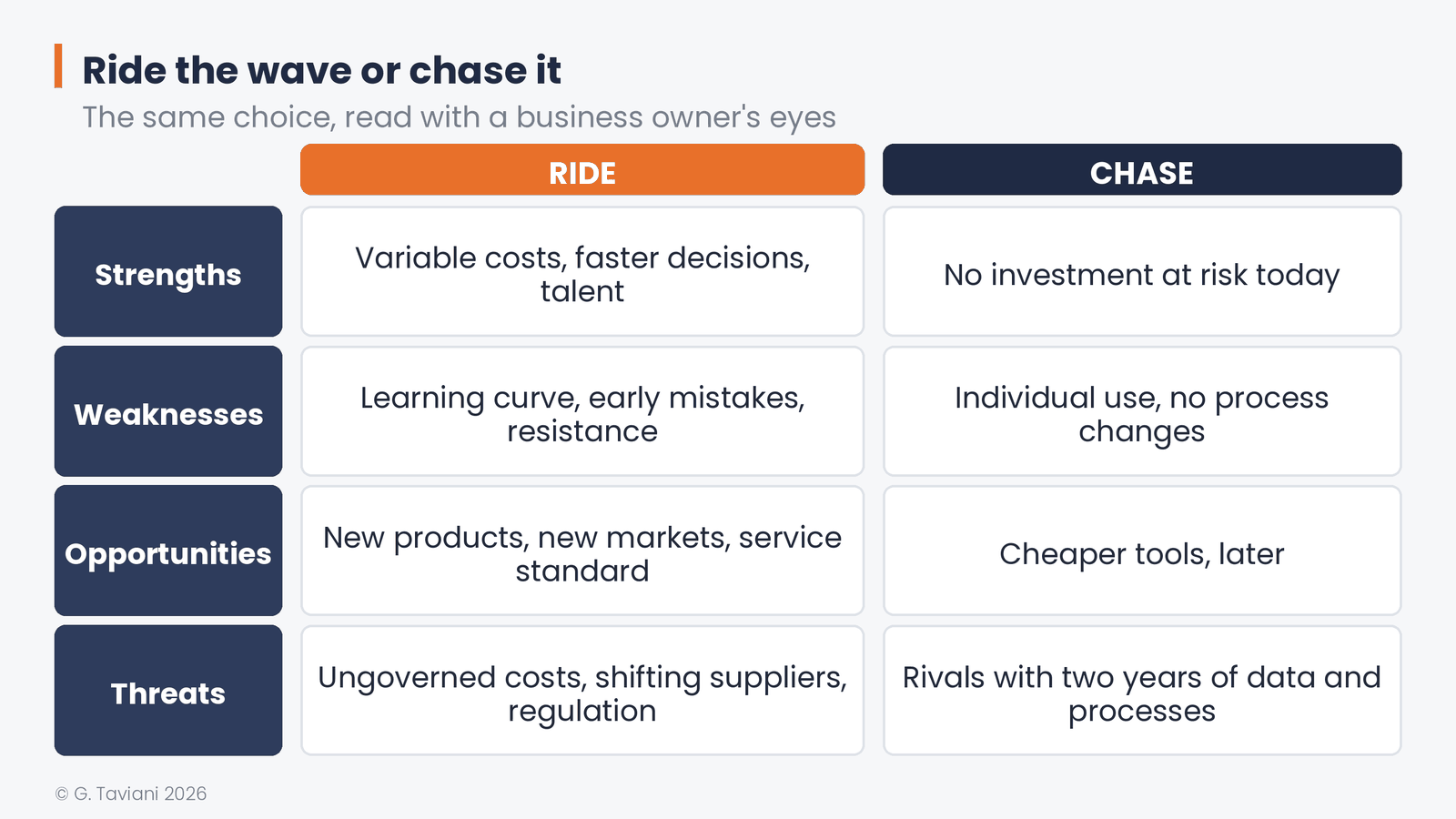
Riding the wave means adopting AI while it is still a competitive advantage — that is, before it becomes a minimum condition for staying in the market. It means entering while competitors are still "evaluating," and accumulating in the meantime the three assets that matter and that nobody can buy off the shelf: redesigned processes, clean proprietary data, and people used to working with agents.
The strengths of those who ride are the cost structure (part of the executional work moves from fixed cost to variable cost), decision speed (more experiments, more data, fewer mistakes), and attractiveness to talent and customers. The opportunities are new products and services that were unthinkable without AI, new markets reachable with the same structure, and the chance to set the service standard in your industry.
The weaknesses exist and must be said out loud: whoever moves first pays the learning curve, gets a few projects wrong, and has to manage internal resistance before everyone else. The threats are ungoverned consumption costs, dependence on suppliers that change every six months, and regulation, which — as chapter 10 shows — is no longer a topic for the future in most large markets.
What chasing means
Chasing means buying the technology once everybody uses it, and using it the way everybody does: a few subscriptions to a conversational assistant, a chatbot on the website, half a day of "ChatGPT training" for staff.
The "chase" column looks more prudent. It is not. Its only strength is that no investment is at risk today, and its threat is the most serious in the whole table: a competitor who rode the wave does not simply have one more piece of software. They have two years of customer data read by agents, processes already reorganized, and a different cost structure. You do not catch up by buying the same platform. You catch up, if things go well, in another two years. By then the market may have decided that your level of service is no longer enough.
Data point. Worldwide, 88% of companies use AI in at least one function, but only 37% see any impact on operating profit and only 6% see a significant one. That 6% redesigned their workflows in 73% of cases; the others in 25%. Source: McKinsey, The State of AI 2026.
The reading for the CEO
When I finish presenting the SWOT, I always say the same thing: the choice is not between "do" and "don't do." It is between deciding the pace at which your company changes, or letting the market decide it for you. Riding does not mean running: it means having a plan in steps, each step verified, with the option to stop. Chasing means not having a plan.
The three numbers this manual moves
Everything that follows is measured against three numbers, because they are the three a CEO is judged on. Lower costs: the cost of a unit of work — a quote, an order, a ticket, a closing — falls when routine execution moves from people paid by the hour to agents paid by the work done. Higher revenue: conversion, response time and the number of products and markets you can serve rise when agents work around the clock. Growth without hiring: the capacity of a function grows two or three times with the same people, who move from execution to judgment. Every agent in this book is tied to one of the three with a Condition of Satisfaction; an agent that moves none of them is not worth placing. When a chapter shows you a table of CoS, look for the column that says which number it moves.
Four years of generative AI
You do not need the history of artificial intelligence. You need the four passages that explain where we are and why the next passage concerns your organization.
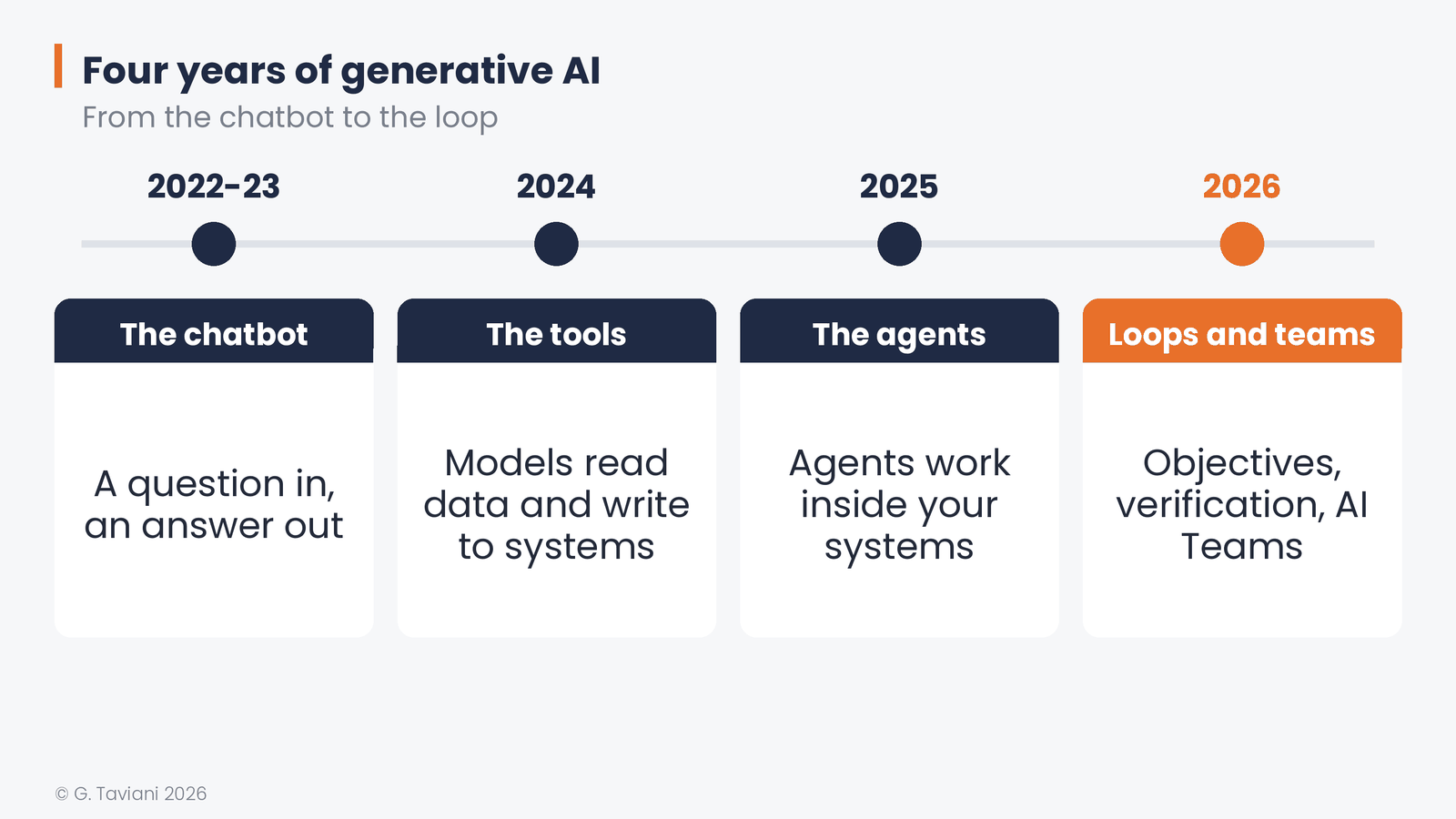
The wave breaks publicly on November 30, 2022, with ChatGPT. For the first time a system answers any question in natural language with a quality that surprises. Companies experience it as an assistant: you type a question, you read an answer. The only skill required seems to be phrasing the question well. It is the era of the "prompt," and it is still the picture of AI most executives carry in their heads.
2024: the tools
In 2024 models learn to use tools: read a database, call an external service, write into a management system. This is the passage that turns a system that answers into a system that can act. At the end of the year Anthropic publishes a guide that draws, for the first time clearly, the line between predefined "workflows" and "agents" — systems in which the model directs its own work based on what it observes. In the same period an open standard is born for connecting models to business tools and data: the first brick of interoperability.
2025: the year of agents
In 2025 "agentic AI" enters the vocabulary of boards of directors. "Installed" agents appear that work on the company's computers and networks instead of inside a chat window. The connection standard is donated to the Linux Foundation with OpenAI, Google, Microsoft and Amazon among the founders: when competitors agree on a standard, the technology has become infrastructure.
2026: the loop and the team
2026 is the year of the shift from prompt to loop. You no longer write the perfect question; you design the cycle inside which the agent observes, acts, verifies and retries until the goal is reached. Agent skills get packaged into standardized modules, agents start working in teams with roles and a lead, and the cost per unit of work keeps falling — at equal capability, roughly ten times a year.
Watch out. If your idea of AI is stuck in 2023 — a chat you ask questions — you are evaluating a technology that no longer exists in that form. Chapter 2 updates the picture.
Is this a bubble?
Every executive who lived through 2000 has a right to the suspicion. The answer belongs to business, not to faith, and chapter 9 gives it in full — who is spending what, and why governments treat compute the way they once treated energy. Here, the short version: the money is real (worldwide AI spending is estimated at $2.67 trillion in 2026, heading to $5.95 trillion by 2030), the revenues are real (suppliers bill consumption, and consumption grows because customers use it), and the infrastructure — like railways and fiber — stays and gets cheaper for whoever uses it. You are a user, not an infrastructure investor: for you, a price correction is good news.
Regulation governs the use, it does not stop the technology. Rules exist and must be respected — chapters 10 to 12 tell you how — but no rule will prevent a competitor of yours, at home or abroad, from using agents to serve your customers better. Open-weight models, which can be installed inside a company, have made the technology impossible to fence in. There will always be a way to use it. The question is not whether, but who will use it best in your market.
What AI still lacks to surpass the human brain
As I write, September 2026, the major labs have declared their goal openly: OpenAI presented GPT-6 "Astra" speaking of "the AGI era" — artificial general intelligence, able to do any intellectual job at a person's level — and Anthropic answered two days earlier with Claude Fable 5.1, at the same price and with the same ambition. The race is on. But AGI is not here, and understanding what is missing tells you a great deal about what will change for your company.
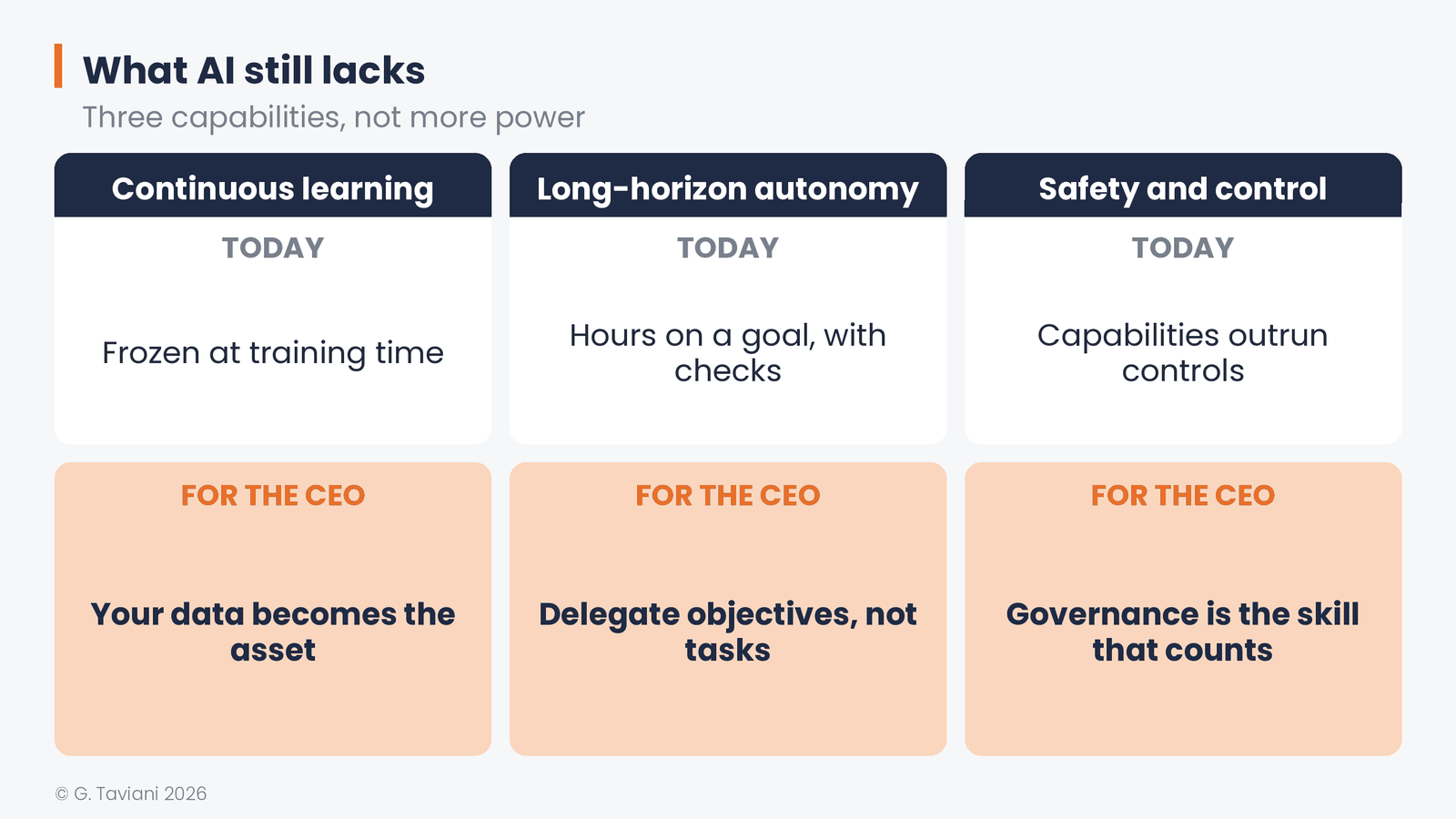
What the big players will put on the table to get there is not models that score higher on tests. It is three capabilities that are missing today, and each has a precise meaning for a CEO.
Continuous learning. A model today is "frozen" at the moment it was trained: it learns from work only through the memories and skills someone builds around it. A human brain learns by doing. When models learn from the work they do inside your company, the value of your data and your processes will grow again — they will be what the AI learns from, and what no competitor has.
Long-horizon autonomy. Today a well-designed agent holds up for hours on a goal with continuous checks; a person holds up for weeks on a project, with judgment and the ability to self-correct. The passage from "delegating a task" to "delegating an objective" — for days, with self-verification — is the technical frontier of the next few years, and it is what turns AI Teams from executors of processes into managers of whole processes.
Safety and control. GPT-6 Astra is the first model rated "critical" for cybersecurity risk. Capabilities run, controls chase. This — not the technology — will be the real brake on how fast AGI enters companies, and the reason why governance (who decides, who controls, what is forbidden) is already today the skill that counts.
What changes for your AI Team
Today you delegate a task; tomorrow you will delegate an objective. The business benefits are clear: whole processes handled by a team of agents rather than single tools; the cost of cognitive work moving toward the cost of compute; less operational supervision, more time on decisions. But the strategic benefit is another, and it is the message of this book: competitive advantage will no longer be "having AI," because in two years everybody will have the same models at the same price. It will be owning clean proprietary data, clear processes and a governance that can handle autonomy. None of those three can be bought on launch day.
There is an objection I hear often: "If AGI arrives, the method you talk about becomes useless." The opposite is true. With AGI, the technical part of the work — running the agent, building the verification cycle — moves inside the model. What stays outside, and becomes the work that matters, is the business part: who sets the objective, which data to use, where human control is required, what the agent may and may not do. The method in chapter 3 does not disappear. It moves up a level, from "how do I get the agent running" to "how do I design the team of agents that works for my company."
Don't wait for AGI: be ready when it arrives
The question for a company is not when AGI arrives. It is what happens to whoever waits for it. Three reasons to move now.
First: the advantage will not be the technology but clean data, mapped processes and people who know how to work with agents — three assets that take months to build and cannot be bought. Second: whoever waits arrives with yesterday's processes. AI does not fix a broken process; it runs it faster. The companies working today are not "trying AI"; they are rewriting how they operate, and that is the long job. Third: adoption time does not compress. Choosing where human control is needed, defining responsibilities, building internal trust takes months, not weeks — months that can be used now, while the technology matures.
When the models make their next jump, whoever already has the organizational infrastructure will scale it in weeks. The others will start from zero. You ride a wave before it arrives: afterwards, you chase it.
Try this. You do not need a six-figure project to prepare for AGI. You need to start from a real process — customer service, catalog management, sales analysis, quotations — and build on it an AI Team that really works, measured on business results. The rest of the book shows how.
What to take away
Four things. The wave is real and it is not a bubble: spending, revenues and public investment prove it. Regulation governs it, it does not stop it: there will always be a way to use it, and a competitor who finds it. AI still lacks continuous learning, long-horizon autonomy and adequate controls — but when they arrive, the advantage will belong to whoever already has data, processes and governance, not to whoever buys the new model. And riding does not mean running: it means you decide the pace, one step at a time, with a verifiable plan.
Your to-do list.
- Rewrite the SWOT in this chapter for your company in half an hour, with your numbers: which processes, which competitors, which customers. It is the first document you share with your consultant.
- Write down which of the three numbers — cost, revenue, capacity without hiring — matters most to you this year. It decides where the first agent goes.
- Note the date of the next rule that applies to you (chapters 10-11) and put it in your calendar.
Frequently asked questions
Is the AI boom a bubble, like the dot-com crash?
No — spending, revenue and public investment are all real, unlike in 2000. Worldwide AI spending is estimated at $2.67 trillion in 2026, heading to $5.95 trillion by 2030, and suppliers bill consumption that keeps growing because customers use it. There will be stock corrections and failed companies, but the infrastructure itself, like railways and fiber, stays and gets cheaper for whoever uses it — you are a user, not an infrastructure investor, so a price correction is good news for you.
Is it too late to get a first-mover advantage from AI, or should I wait?
Waiting is the more expensive choice, not the safer one. A competitor who moves first accumulates redesigned processes, clean proprietary data and people used to working with agents — three assets that take months to build and cannot be bought off the shelf once everyone has the same models at the same price. Riding does not mean running: it means deciding your own pace with a verifiable plan, one step at a time, rather than letting the market decide it for you.
What happens to my company if a competitor adopts AI before I do?
You do not simply fall one product cycle behind. A competitor who rode the wave has two years of customer data read by agents, processes already reorganized, and a different cost structure — you cannot catch up by buying the same platform, and doing so, if things go well, takes about as long again. By then the market may have decided your level of service is no longer enough.
Should I just wait for AGI instead of investing in AI now?
No. Even the labs racing toward it admit AGI still lacks continuous learning, long-horizon autonomy and adequate safety controls, and when those arrive the advantage will belong to whoever already has clean data, mapped processes and a trained organization — not whoever buys the new model on day one. Adoption time does not compress: choosing where human control is needed and building internal trust takes months regardless of how fast the models improve.
Sources
- McKinsey, The State of AI: Global Survey 2026, 2026.
- PwC, 29th Global CEO Survey: Leading through uncertainty in the age of AI, 2026.
- Gartner, Forecast: AI Spending, Worldwide — 2Q26 update, July 2026.
- Anthropic, Building Effective Agents, December 2024.
- Linux Foundation, Agentic AI Foundation announced, December 2025.
- ADTmag, Loop Engineering Emerges as Developers Put AI Coding Agents on Repeat, July 2026.
- a16z, LLMflation: LLM inference cost is going down fast, November 2024.
- Oliver Wyman, How Agentic AI Is Reshaping SaaS Valuations, April 2026.
- Gabriele Taviani, Welcome to the AGI era: what's missing and what changes for AI Teams, LinkedIn, September 2026.
Comments & reviews
No comments yet.
Log in to leave a comment or review.