3. The Method: Commitments, Loops, Conditions of Satisfaction
This is the chapter I ask you to read twice. It is not knowledge to acquire: it is strategic training, a way of thinking you will use for everything — to design the reorganization, to ask work of agents, to evaluate a consultant, to govern the relationship between people and agents in your company.
I did not invent the method. It was born forty years ago to solve a problem that seemed very far from AI — how to coordinate work between people inside organizations — and it has come back into fashion precisely because AI agents have the same problem. It is called Action Workflow, it was formulated by Terry Winograd and Fernando Flores, and I simply call it "the W&F method." By the end of this chapter you will know how to write a request that a person, a consultant or an agent cannot misunderstand.
Where it comes from
Two people, one idea
Fernando Flores is a Chilean engineer, finance minister under Salvador Allende, imprisoned for three years after the 1973 coup; he arrives in the United States in 1976 and studies philosophy of language. Terry Winograd is one of the pioneers of artificial intelligence at MIT, then a professor at Stanford, where he will mentor Larry Page, the founder of Google. In 1986 they publish a book together, Understanding Computers and Cognition, with a thesis that sounds immediately familiar to any executive: organizations are not machines that process information; they are networks of commitments. When you ask, promise, accept or refuse, you are not transmitting data: you are performing an action that creates a commitment between two people.
From that thesis come a piece of work-coordination software, a method patented in the United States in 1993-94, and a school of management — "management by commitments" — adopted by large companies in the following decades.
Why it is useful again
Forty years later, AI agents have digitized this model almost without knowing it. An agent's technical cycle — observe, reason, act, evaluate — is the execution phase of the method. What is missing from most AI projects are the other phases: the clear request, the negotiation before executing, the formal acceptance of the result. And those are exactly the phases missing from most human organizations as well: according to Flores, the best companies keep about 60% of the commitments they make; ordinary ones keep 30%.
For you the news is good: the method you need to make agents work well is the same one you need to make people work well. Learn it once and it serves both.
The loop of the method
Four phases
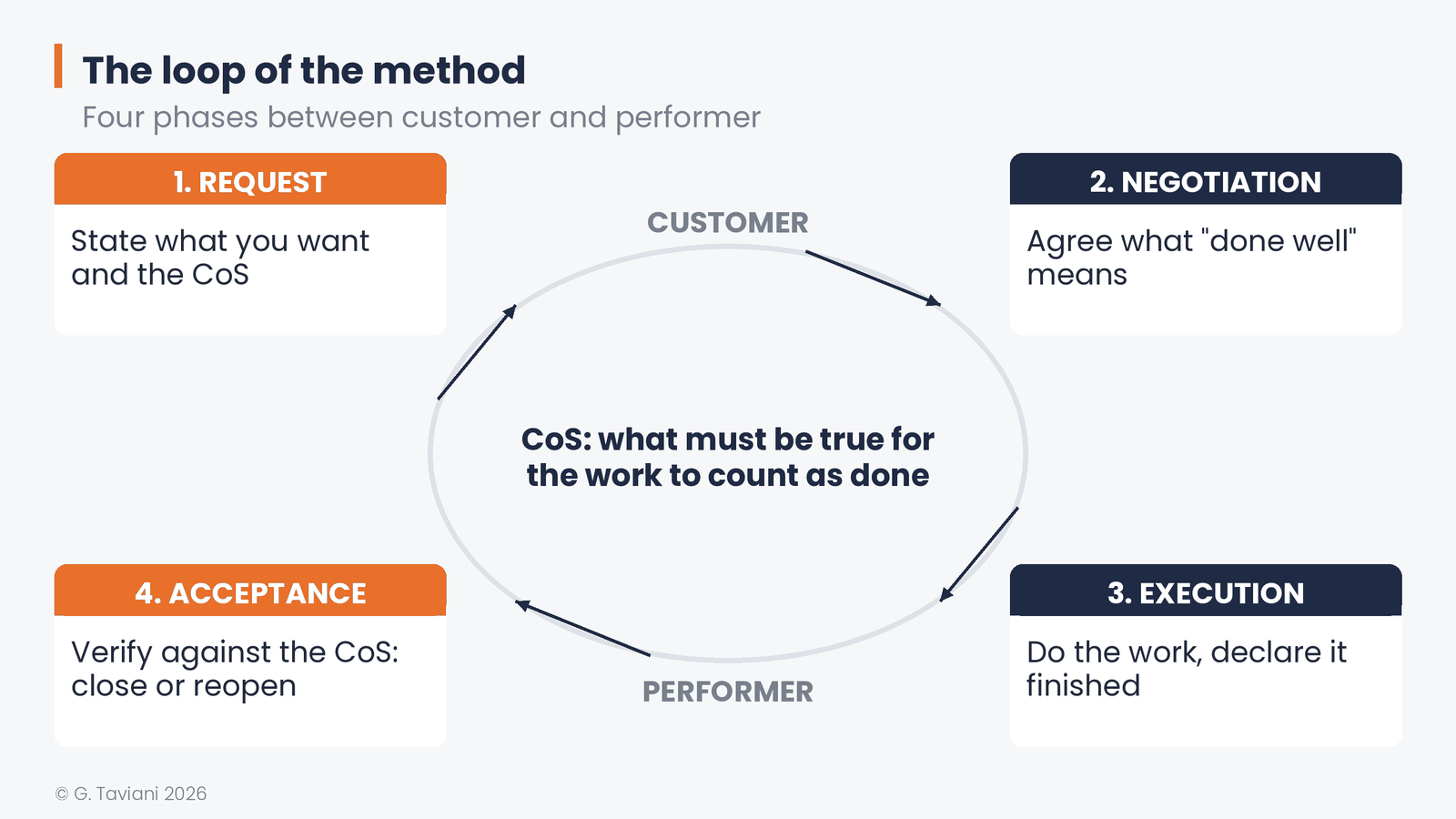
The method describes every piece of work as a cycle — a loop — between whoever asks (the customer of the commitment: you, one of your managers, a coordinating agent) and whoever performs (the performer: an employee, a consultant, an agent). The cycle has four phases.
In the Request, whoever asks states what they want and — this is the point — declares the conditions that must be true for the work to count as done well. In the Negotiation, the two parties agree on what "done well" means: the performer can accept, decline, counter-propose; the cycle continues only when there is an explicit commitment. In the Execution, the performer does the work and declares completion. In the Acceptance, whoever asked checks the result against the agreed conditions and declares satisfaction — closing the loop — or reopens it.
When a cycle is interrupted — the work cannot be done as agreed, a piece of data is missing, a condition turns out to be unrealistic — the method calls it a breakdown. A breakdown is not a failure: it is the moment the network of commitments becomes visible and must be renegotiated. In an ordinary organization breakdowns are hidden (work "more or less done," delays not declared); in the method they are declared immediately, and the parties go back to negotiation.
For a CEO this is the key to governing agents without checking them one by one: a well-designed agent declares the breakdown and asks a person, instead of insisting or inventing. And a serious consultant declares the breakdown when a step of the project misses its result, instead of hiding it in the report.
Conditions of Satisfaction
What they are
The whole method rests on one concept: Conditions of Satisfaction — CoS for short. They are the conditions, declared before the work starts and agreed between whoever asks and whoever performs, that must be true for the work to count as complete. They are not "objectives" in the generic sense: they are verifiable criteria, with a measure, a threshold, a time.
Without explicit CoS the request is vague, the execution is interpretive and the acceptance is arbitrary. That is the normal condition of most work in companies, and it is why so many meetings end with "we understand each other" and so many projects with "that's not what I meant."
Anatomy of a CoS
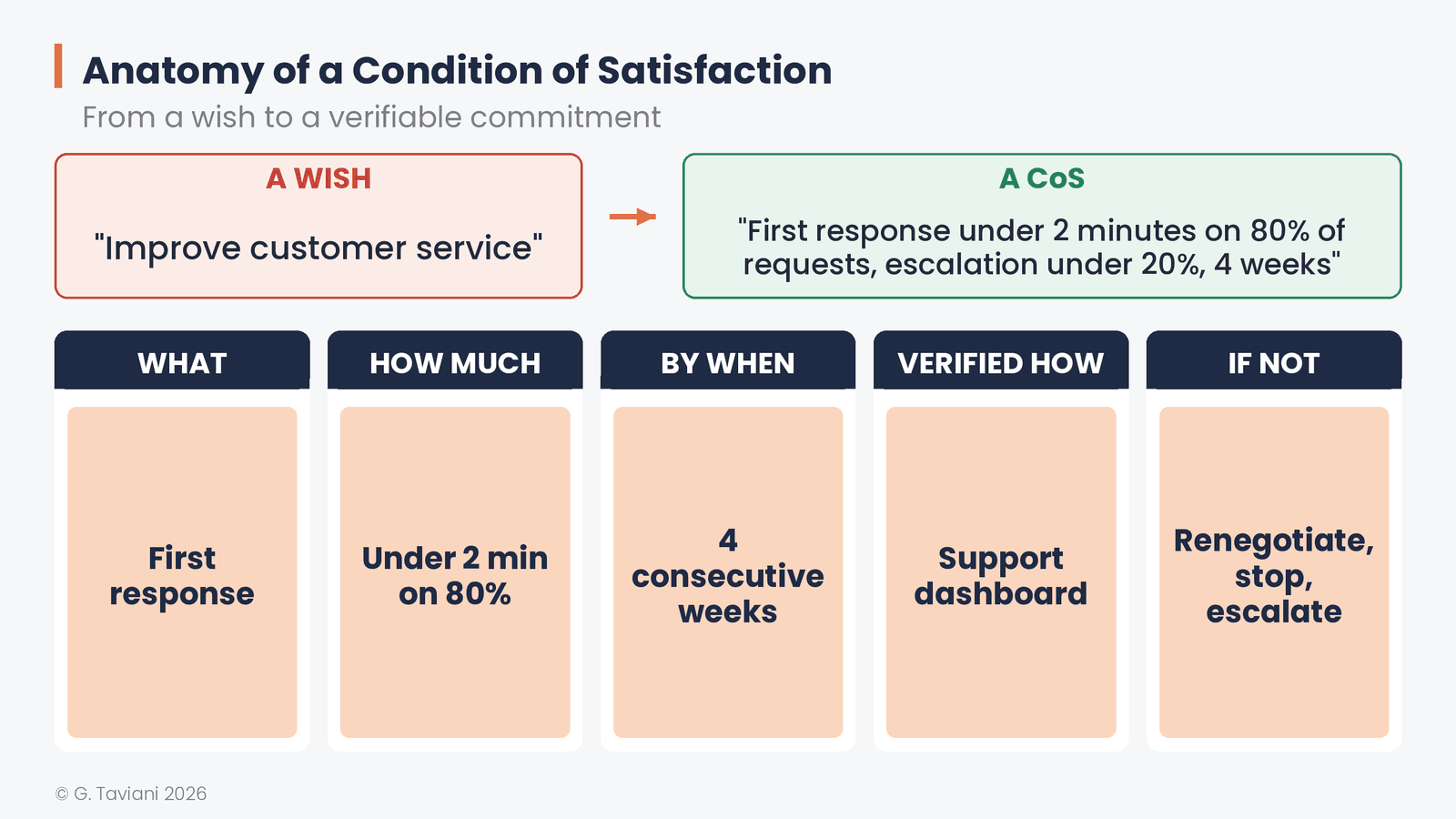
A CoS is not "improve customer service." It is: "average first-response time under two minutes on at least 80% of requests, with escalation to a person under 20%, measured on the dashboard for four consecutive weeks." The first sentence is a wish. The second is a commitment that can be verified, and on which two parties — you and your consultant, your manager and their AI Team — can say "done" or "not done" without arguing.
Why CoS are the CEO's tool
I ask you to make CoS the instrument of request for every design and every execution in your company, for three reasons.
The first is that they free you from having to understand the technology. You do not need to know how an agent recovers an abandoned cart or reconciles an invoice: you need to be able to say what must be true when it is finished, and verify it. The CoS is the language in which a CEO speaks to a technical system without becoming technical.
The second is that they make consultants and suppliers comparable. Whoever agrees to sign a project with verifiable CoS for every step takes on responsibility; whoever proposes "an innovation journey" without CoS is selling you hours. Chapter 8 makes this a selection criterion.
The third is that they change how your organization works, with or without AI. A manager who learns to ask their people with CoS becomes a better manager, and their people finally know what "done well" means. I have seen companies where adopting the method for agents improved the quality of meetings between people before the first agent went into production.
Watch out. The CoS I most often see CEOs write is "reduce costs." It is not a CoS: it does not say which costs, by how much, by when, measured how, and what happens otherwise. Turning it into "reduce cost per order handled by 20% within six months, measured by finance, with monthly review and a stop if complaints exceed 3%" takes ten minutes and changes the whole project.
Applying the method to everything
To designing the reorganization
The first use of the method is your transformation plan. Every step of the plan — from audit to first agent, from first agent to first AI Team, from first team to the mixed organization — is a complete cycle: you ask with CoS, the consultant negotiates (accepts, declines, counter-proposes with their numbers), executes, and at the review you accept or reopen. No step closes without negotiated and verified CoS. No next step starts until the previous one is accepted.
This gives you two things no traditional technology project gives: the ability to stop at any step without having "wasted" the investment, because every step has produced a verified result; and transparency on breakdowns, which surface immediately instead of at the end.
To creating new products and services
The second use is designing what you sell. A new service conceived with AI — support that answers in two minutes at any hour, an offer personalized for every customer, a quote in an hour instead of three days — is born from CoS written from the end customer's point of view: what must be true for them for the service to be worth the price. The same CoS then become the conditions you give the AI Team that will deliver that service. Chapters 4 and 7 show examples.
To the relationship between people and agents
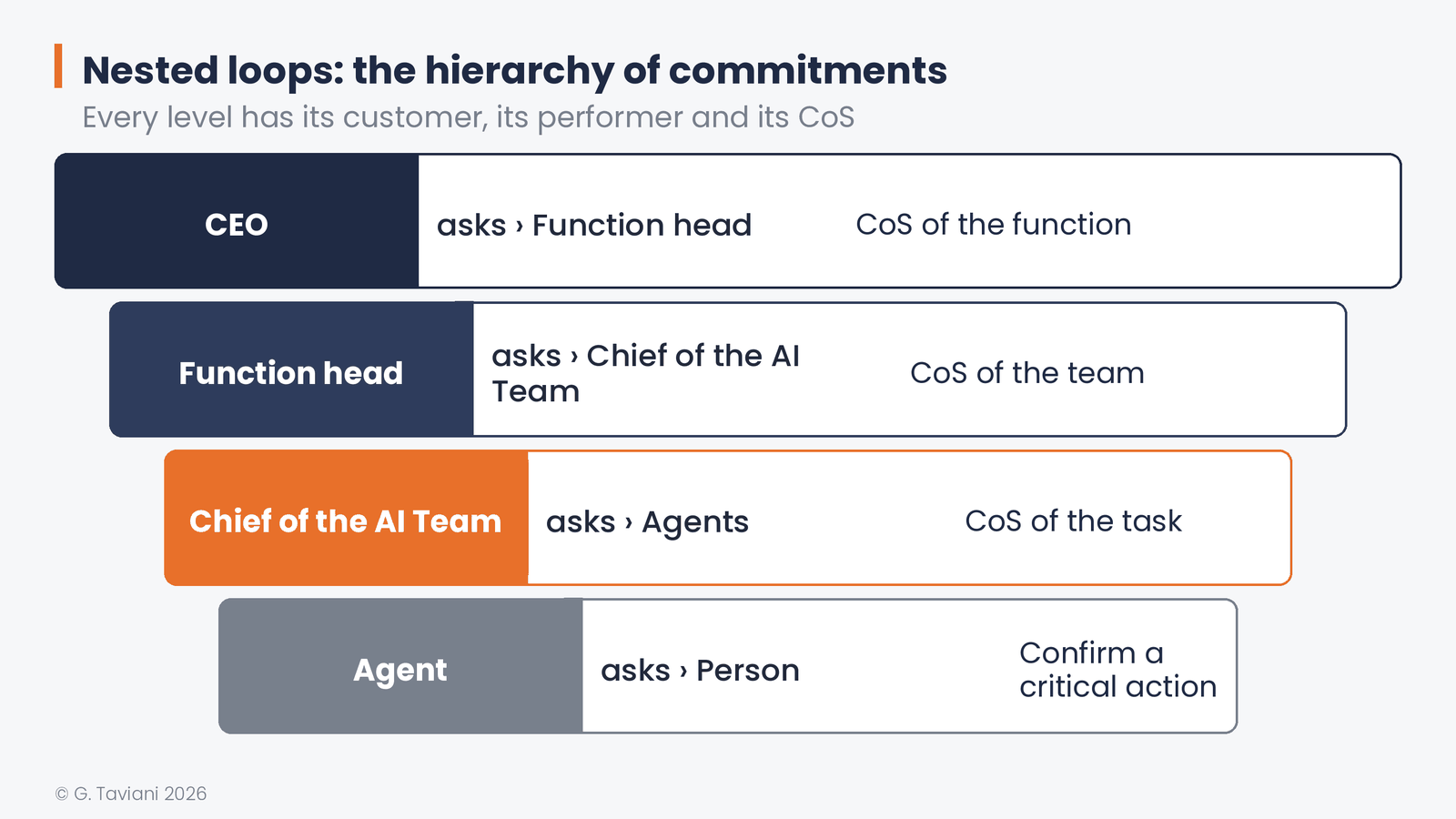
The third use is daily. In a company with AI Teams, work is organized as a hierarchy of commitments: you ask the function head with CoS; the function head asks the chief of their AI Team with CoS; the chief asks the individual agents with CoS; an agent asks a person to confirm a critical action — and this is the role inversion: for a moment the agent is the customer and the person is the performer. Every level has its own cycle and its own conditions. Designing the AI-first organization means drawing this hierarchy and making sure every link closes with a verification.
The fourth use is the technical one, and you need to know it only to demand it. A well-designed agent does not receive a "prompt": it receives a structured task with a title, a description of intent that does not change, the technical and semantic CoS, and the skills to activate. It works in a loop until the CoS are verified; after a maximum number of attempts it declares a breakdown and asks. The agreed CoS are recorded somewhere the agent cannot edit. This is what a qualified consultant builds, and what you should ask to see: not the code, but the structured task and the CoS register.
Data point. In systems that apply a commitment protocol between agents, the metrics measured are: CoS met on the first cycle (target above 70%), renegotiations (under 20%), breakdowns (under 5%). When breakdowns rise, the problem is almost always upstream — badly negotiated CoS or missing skills — not the model. Source: G. Taviani, The AI Consultant's Handbook, chapter "The Method," 2026.
And when AGI arrives?
A fair question: if models learn to build the verification cycle on their own — and the latest ones already reason in loops internally — will the method still be needed? Yes, and more than before. What moves inside the model is the technical part of the loop: running the agent, verifying, retrying. What stays outside is the business part: who sets the objective and its CoS, which data to use, where human control is required, what the agent may and may not do. The method moves up a level, from "how do I get the agent running" to "how do I design the team of agents that works for my company." And that is exactly the level where a CEO belongs.
The method in three sentences
For strategy: no step of the plan closes without CoS negotiated and verified with you. For design: no agent, no service, no reorganization is built without CoS written first. For execution: nobody — person or agent — declares the work done until the CoS are verified, and no piece of work runs forever without asking.
Your to-do list.
- In your next management meeting, close every decision with a written CoS: what must be true, how much, by when, verified how, what happens otherwise. By the third meeting you will wonder how you managed before.
- Take one wish already in circulation ("improve customer service") and rewrite it as a CoS with the five elements.
- Ask your consultant to show you a CoS register from a real project, not the code.
Where to look. The method in this chapter, in its operational form for consultants and agents, is described in The AI Consultant's Handbook and underpins the qualification path of the AI Workspace Club (aiworkspace.club): a consultant qualified there works with the same CoS you have just learned.
Frequently asked questions
How do I write instructions for an AI project so nothing gets lost in translation?
Use a Condition of Satisfaction: a verifiable criterion with a measure, a threshold and a time, not a vague wish. "Improve customer service" is a wish; "average first-response time under two minutes on at least 80% of requests, with escalation under 20%, measured for four consecutive weeks" is a commitment two parties can call "done" or "not done" without arguing.
How do I know if an AI project actually succeeded, and not just looks finished?
Check it against the Conditions of Satisfaction agreed before the work started: what must be true, how much, by when, verified how, and what happens if it is not true. Without explicit CoS the request stays vague, the execution becomes interpretive, and acceptance turns arbitrary — which is why so many projects end with "that is not what I meant."
What happens when an AI agent hits a problem it can't solve — does that mean the project failed?
No. That moment is called a breakdown: the declared interruption of a cycle when work cannot proceed as agreed, data is missing, or a condition turns out unrealistic. A well-designed agent declares the breakdown and asks a person instead of insisting or inventing an answer, and a serious consultant does the same instead of hiding a missed result in a report — it is the moment a commitment becomes visible and gets renegotiated, not a sign of failure.
Is there a proven method for managing AI agents, or is everyone just improvising?
The method used across this book, Action Workflow, is forty years old: Terry Winograd, an AI pioneer at Stanford, and Fernando Flores, a philosopher and former Chilean finance minister, published it in 1986 on the idea that organizations run on networks of commitments, not just information. It resurfaced for AI because agents run into exactly the same coordination problem people do — the same discipline that makes people work well together makes agents reliable too.
Sources
- Winograd T., Flores F., Understanding Computers and Cognition: A New Foundation for Design, Addison-Wesley, 1986.
- Medina-Mora R., Winograd T., Flores R., Flores F., The Action Workflow Approach to Workflow Management Technology, CSCW, 1992.
- Google Patents, US5630069A — Method and apparatus for creating workflow maps of business processes, 1997.
- strategy+business, Fernando Flores Wants to Make You an Offer, 2007.
- Coevolving Innovations, Conversations for action, commitment management protocol.
- Anthropic, Building Effective Agents, December 2024.
- Dhuliawala S. et al., Chain-of-Verification Reduces Hallucination in Large Language Models, 2023.
- Gabriele Taviani, The AI Consultant's Handbook — chapter "The Method", 2026.
- Gabriele Taviani, From Prompt to Agentic Loop, GTAVIANI blog, 2026.
Comments & reviews
No comments yet.
Log in to leave a comment or review.