6. AI, Marketing and Sales
Marketing and sales are where AI produces the fastest and most visible results, and also where most CEOs get misled: because the field is full of suppliers selling "AI" as features bolted onto the software you already use, and because it is easy to confuse more activity (more content, more emails, more ads) with more results.
This chapter gives you three numbers, a funnel and a rule. The three numbers are the ones that govern every commercial activity: the cost of acquiring a customer, the conversion rate and the customer's value over time. The funnel shows where agents intervene. The rule is that every commercial agent must be tied to one of those three numbers with a Condition of Satisfaction; otherwise it is producing activity, not results. By the end you will be able to write the CoS for your first commercial agent.
The three numbers
Acquisition cost
Customer acquisition cost (CAC) is what you spend to win a new customer: advertising, agencies, salespeople's time, tools. It has been rising for years in almost every industry, because attention costs more and more. AI acts on this number in three ways: it makes ad buying more precise (the major platforms' algorithms, when governed with clear objectives, cut cost per result by 20-35%); it cuts the cost of content (texts, images and variants at a fraction of the cost, with reductions of 60-75%); and — above all — it wastes no leads: a lead contacted within five minutes is nine times more likely to convert than one that waits two days, and an agent always answers within five minutes.
Conversion rate
The conversion rate is the share of leads, visits or quotes that become sales. It is the number agents move best, because conversion depends on continuity, speed and relevance: three things an agent guarantees and a person cannot. In online retail, visitors arriving from an AI assistant convert 54% better than those from other channels; in B2B, automatic lead qualification improves by 25-40% the share of genuinely interested leads that reach the salesperson.
Customer lifetime value
Customer lifetime value (CLV) is what a customer earns you over the whole relationship. It is the most neglected number and the most profitable, because acquiring a customer costs several times more than keeping one. AI acts here with continuous personalization (offers, content and timing tailored to each customer, not each segment), with churn prevention (the agent sees the signals of a customer about to leave and acts first) and with continuous after-sales support. Predictive retention tools raise customer value by 25-40%.
| Number | Where agents act | Expected effect (6-12 months) |
|---|---|---|
| Acquisition cost | Governed ad buying · content at a fraction of the cost · no lead left waiting | −15/30% |
| Conversion rate | Qualification 24/7 in every language · recovery of open carts and quotes · AI-referred visitors convert +54% | +10/30% |
| Customer lifetime value | Personalization per customer · churn prevention on signals · after-sales always on | +25/40% |
Data point. Most AI programs in marketing and sales reach breakeven in 90-180 days; the fastest returns are on ad buying (2-4 months) and on lead response. Source: Data-Mania, AI Marketing ROI Benchmarks 2026 — a compilation of sourced benchmarks; treat as orders of magnitude.
The funnel with agents
The simplest way to see where agents intervene is to follow the customer's path, from first attention to loyalty. At every stage there is a typical agent, a number that governs, and a mistake to avoid.
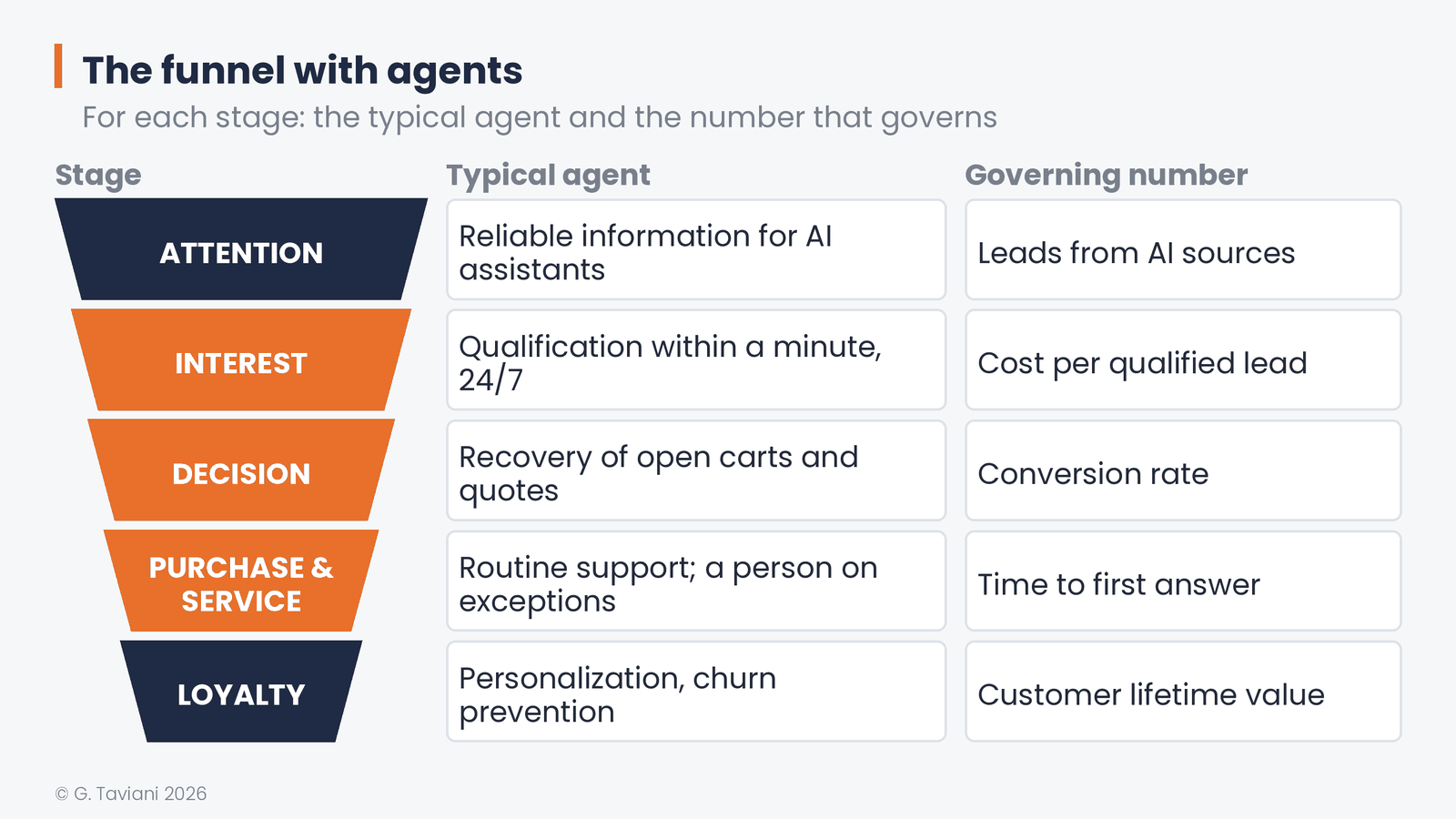
The first stage has changed more than any other. Your customers — consumers and companies — increasingly ask an AI assistant to find, compare and propose. Traffic to US retail sites from AI assistants grew fourteen-fold in eighteen months; Salesforce estimated that AI and agents drove 21% of global online holiday orders in 2025. If the information about your product is not readable, complete and consistent for those assistants, you are not proposed. The typical agent here does not sell: it keeps information on products, services, prices and availability updated, consistent and complete across every channel, and monitors how your products are described by the assistants. The governing number is the share of traffic and leads from AI sources. The mistake is producing more content instead of more reliable content.
Interest: qualifying around the clock
The second stage is qualification: understanding who, among those who contact you, is worth a salesperson's time. It is the job an agent does better than anyone: it answers within a minute, at any hour, in any language, asks the right questions, collects the data, assigns a priority and passes to the salesperson only the leads that are ready, with a complete record. The governing number is the cost per qualified lead. The mistake is the website chatbot that answers everything and qualifies nothing.
Decision: recovering and convincing
The third stage is where the customer decides, and where most sales are lost: abandoned carts, unanswered quotes, expired offers. The typical agent follows every open opportunity — with the right message, at the right moment, with the minimum incentive needed — and closes or hands back to the salesperson with a reason. In retail, cart recovery and product recommendation are almost always the first agents I recommend: low risk, measurable result in four weeks. In B2B, the agent that prepares a quote in an hour instead of three days changes the closing rate more than any discount. The governing number is the conversion rate. The mistake is aggressive automation — bursts of messages that burn the customer.
Purchase and service: always answering
The fourth stage is support during and after the purchase: order status, returns, sizes, usage questions. In retail, 80% of requests concern information already in the systems; an agent handles them, a person supervises the exceptions. The governing number is time to first answer together with the escalation rate to a person. The mistake is hiding from the customer that they are talking to an agent: beyond being illegal in a growing number of markets, it destroys trust.
Loyalty: personalizing and preventing
The fifth stage is the ongoing relationship. The typical agent reads each customer's behavior, proposes the right content or offer at the right time, and — above all — recognizes the signals of churn and acts first. The governing number is customer lifetime value and repeat-purchase rate. The mistake is confusing personalization with intrusion: the agent needs precise rules on frequency, tone and limits.
Example. A home-goods e-commerce with $4.5 million in revenue spent 22% of it on acquisition. A commercial AI Team — one agent for lead qualification, one for recovering lost sales, one for personalizing communication to existing customers — brought acquisition cost from 22% to 15% of revenue in six months, conversion from 1.8% to 2.4%, and the share of revenue from existing customers from 31% to 44%. The external agency stayed, with a different mandate: it governs channel strategy; it no longer runs the operations. (Case anonymized.)
What changes in the commercial organization
Salespeople go back to selling
In most companies salespeople spend an enormous share of their time on activities that are not selling: preparing quotes, chasing answers, updating the CRM, answering repetitive questions. With an AI Team that time returns to selling: to the relationship with high-value customers, to complex negotiations, to visits. The role changes from "manager of activities" to "closer of qualified opportunities," and the measure of the job changes with it.
Marketing becomes governance, not production
Marketing stops being a content factory and becomes a governing function: it defines positioning, tone, rules and Conditions of Satisfaction for the agents, reads the dashboards, decides the experiments. With an AI Team you can run fifty experiments a week — on messages, offers, segments — where you used to run five a month. The marketing head of an SME becomes, in practice, the editor of a newsroom and the director of a lab, with a team of agents in place of manual production and executional agencies.
External agencies change trade
Agencies that did executional work — content, campaign management, support — are replaced by agents or change trade: from producers to governors of the agents on your behalf. It is a change you must drive, renegotiating contracts on results (the three numbers) instead of activities. Whoever refuses the renegotiation is telling you their value was in the execution.
CoS for the commercial function
To help you ask well, here are the Conditions of Satisfaction I use most often for commercial agents. They are examples: the thresholds depend on your starting point.
| Agent | Example CoS | Moves | Verification |
|---|---|---|---|
| Lead qualification | First answer within 2 minutes on 95% of leads, 24/7; at least 30% of leads passed to sales close within 60 days | Revenue | Lead dashboard + CRM, monthly review |
| Recovery of lost sales | At least 12% of abandoned carts/quotes recovered within 72 hours, with average incentive under 5% | Revenue | Sales platform, monthly |
| Routine support | First answer under 2 minutes on 80% of requests; escalation to a person under 20%; satisfaction above 4.5/5 | Cost · Capacity | Support dashboard, four consecutive weeks |
| Personalization | Revenue from existing customers +20% in six months; unsubscribes under 0.3% per send | Revenue | Email/CRM platform, monthly |
| Churn prevention | Churn of active customers −25% in twelve months | Revenue | CRM, quarterly |
What to take away
Three numbers govern the commercial function — acquisition cost, conversion, customer lifetime value — and every agent must be tied to one of them with a CoS. Agents intervene along the whole funnel, but the first to place are the low-risk, fast-return ones: qualification, recovery, routine support. And the market has already changed: being found by AI assistants is the new first stage.
Watch out. Distrust anyone offering you "AI for marketing" as features added to the software you already use: text generators, subject-line suggestions, images. Those are individual productivity tools, not agents. The test is always the same: which of the three numbers does it move, by how much, verified how?
Your to-do list.
- Write your three numbers as of today — acquisition cost, conversion, customer value — with the date. If you do not have them, ask finance before any agent.
- Choose the first commercial agent from the low-risk three: qualification, recovery, routine support.
- Renegotiate one agency contract from activities to results, using the three numbers.
Frequently asked questions
How much can AI actually reduce my customer acquisition cost?
Expect a range, not a single number: governed ad-buying algorithms with clear objectives typically cut cost per result by 20-35%, AI-generated content cuts production cost by 60-75%, and no lead sits waiting because an agent always answers within five minutes. Tie any commercial agent to one of three numbers — acquisition cost, conversion, customer lifetime value — with a Condition of Satisfaction, or it is producing activity, not results.
Why does responding to a sales lead within minutes matter so much?
Because speed is the single biggest lever on conversion: a lead contacted within five minutes is nine times more likely to convert than one that waits two days, and a person cannot guarantee that response time around the clock — an agent can. Lead qualification is one of the low-risk, fast-return agents to deploy first for exactly this reason.
Is AI-generated marketing content the same as having an AI sales agent?
No. Text generators, subject-line suggesters and image tools are individual productivity add-ons that improve one person's output; they are not agents working toward a commercial objective. The test is the same one used for any supplier claim: which of the three numbers — acquisition cost, conversion, customer lifetime value — does it move, by how much, verified how?
Is it OK to hide from customers that they're talking to an AI?
No — and it is a mistake on two levels. Beyond being illegal in a growing number of markets, hiding the agent destroys trust the moment the customer figures it out. About 80% of routine support requests concern information already sitting in your systems, so an agent can answer them well; it should just never pretend to be a person doing it.
Sources
- Data-Mania, AI Marketing ROI Benchmarks 2026: Pipeline, CAC, Conversion & Payback Data, 2026.
- Adobe Analytics via Digital Commerce 360, AI-referred traffic to retail sites doubles in a year, June 2026.
- Salesforce, AI and Agents Present a $263B Holiday Opportunity for Retailers, 2025.
- Ringly, 42 AI in retail statistics you need to know in 2026, 2026.
- CX Dive, Klarna changes its AI tune and again recruits humans for customer service, 2025.
- Gabriele Taviani, E-Commerce AI Team: which agent to deploy first, GTAVIANI blog, 2026.
Comments & reviews
No comments yet.
Log in to leave a comment or review.