5. AI and the Organization
The previous chapter showed where AI intervenes in the business model. This one answers the question that follows immediately: "And my organization? My people?" It is the right question, because the reason most AI projects fail to produce value is not technological: it is organizational. RAND estimates that more than 80% of AI projects fail — twice the rate of ordinary IT projects — for causes like a badly defined problem, shifting priorities and attention to the technology instead of the problem. Prosci finds that 63% of organizations name human factors as a primary challenge in AI implementation, and 43% attribute failure to insufficient executive sponsorship.
Integrating agents and AI Teams into the organization means three things: changing the org chart, reskilling people, and governing the reactions. By the end of this chapter you will know which process to start with, who will supervise the first agent, and who must be in the room before any agent is.
What integrating agents and AI Teams means
The org chart becomes mixed
A single agent changes a process. An AI Team changes the org chart. The destination — the AI-first company — is not a company without people: it is a company that has decided clearly where people are worth the most and has entrusted the rest to governed teams of agents.
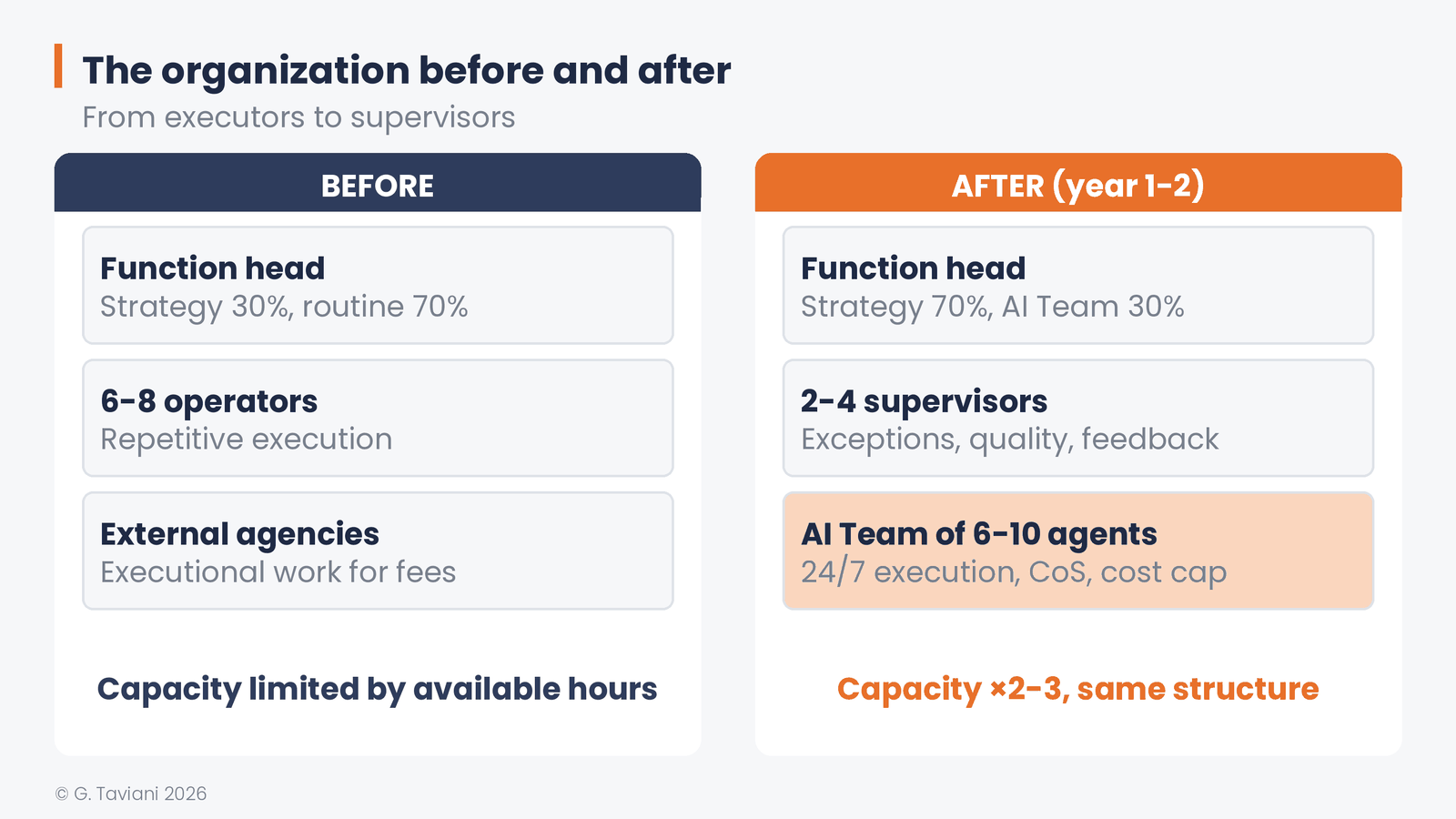
In the mixed org chart, next to each human function appears, where it makes sense, an AI Team with a lead (the chief) reporting to the function's human head. The head does not "use" the team: they direct it, with objectives and Conditions of Satisfaction, exactly as they direct their staff. The function's people change role: from executors to supervisors, exception handlers and owners of quality.
The criterion for deciding what goes to agents and what stays with people is always the same: what is routine and verifiable goes to agents; what is judgment, relationship and responsibility stays with people. In practice, 70-80% of a process's routine tasks move to agents; 20-30% — risks, exceptions, decisions with P&L impact — stay at human checkpoints.
There are three, and they should be ranked in the reverse order of how they are usually pitched.
The first, and least interesting, is the reduction of executional labor cost: hours freed, overtime avoided, external costs (agencies, outsourced services) replaced. It is real and measurable in the first 30-60 days, but by itself it does not justify a transformation.
The second is capacity: the same structure serves more customers, more markets, more hours a day. A company that handled a thousand orders a month handles three thousand without hiring; one that answered within the day answers within minutes, at night and on weekends. This is the advantage that shows in revenue.
The third, and most important, is decision quality: with data read by agents and processes documented, your managers decide more often, with more information and fewer mistakes. This is the advantage that shows in margin from year two, and that competitors cannot copy.
Reskilling and valuing people
The most delicate topic must be said without hypocrisy: with agents, staff tied to pure execution shrink, or get reorganized. In my experience the second scenario is more frequent and more convenient. Whoever answered a hundred requests a day becomes whoever supervises the agent that answers, handles exceptions and reads satisfaction trends. Whoever did data entry becomes whoever checks the quality of the data the agents work with. The manager who spent 60-70% of the time on routine returns to strategy.
Reskilling must be explicit: a new role, with a new title, dedicated training and — where possible — a pay recognition. In the projects I follow the new roles are called AI operations coordinator and analytics and optimization lead, and they are held by people who used to do executional work. It is the difference between a person who feels replaced and one who feels promoted.
Data point. In 2026, 39% of executives worldwide expect net job reductions because of AI, but only 14% actually experienced them in the past year; 66% saw little or no change. The gap between fear and reality is the space in which a CEO can design reskilling instead of suffering fear. Source: McKinsey, The State of AI 2026.
What to expect from people
Hostility is not irrational
Whoever has done a repetitive job for years has built their security on it; seeing an agent execute it continuously is a concrete threat, not a perception. Pretending otherwise is the surest way to make the project fail. Among workers in organizations adopting AI, 23% consider it likely that their job will be eliminated within five years (Gallup, 2026); worldwide, 41% worry their role could disappear within a decade (BCG, 2025). And only 26% of employees say their leadership is clearly aligned on an AI strategy (Microsoft, 2026).
The reactions to expect come in four kinds, and you will recognize each face. Open refusal ("it will never work here"), typical of those with the most experience and the most to lose. Passive resistance, the most dangerous: the project is accepted in the meeting and sabotaged in the details — data not provided, exceptions not reported, agents not supervised. Retaliation: in the worst cases, the flight of key people to competitors, or the use of personal AI tools outside any control — the "shadow AI" that in most surveys involves a third or more of employees. And disconnected enthusiasm: the willing colleague who builds automations on their own, without strategy, creating what I call "the graveyard of agents."
How it is governed: three levers
I manage it in three ways, and I ask you to demand them from your consultant.
Transparency. The reorganization plan is presented to the people involved with the real numbers, including what changes in roles. You do not present "an innovation project": you present who will do what in six months. People can handle hard news; they cannot handle uncertainty.
Gradualness. One agent at a time, with a pilot that involves whoever does that job today as the agent's supervisor, not as its victim. And the supervisor of the first agent must be the person with the most experience and the most criticism: they know the exceptions no document describes. If the project convinces them, it will convince everyone; if it does not, you have found a problem before scaling it.
Explicit reskilling. New role, new title, dedicated training — which, at that point, is not "how to use a conversational assistant" but "how to work with your AI Team": read the dashboard, handle exceptions, give feedback to the agent, know when to stop it. In most jurisdictions this training is also what the law now asks of companies using AI: an adequate, documented level of AI literacy for the people who operate it. Chapters 10 to 12 cover it.
Watch out. Your behavior toward your executives and managers matters more than any plan. If you delegate AI "to IT" or "to a young colleague," your managers will understand it is not a priority and treat it as such. If you present it as your decision, with your objectives, with your presence at the monthly reviews, they will treat it as the company's decision. McKinsey's high performers are more than twice as likely to report visible commitment from senior leadership; Microsoft finds that a manager who openly uses AI lifts the team's perceived value of AI by 17 points and trust in agents by 30.
The right order: strategy, organization, agents, training
Almost every company I meet has already "done AI training": half a day on how to use an assistant. It is a harmless and useless activity: it improves how each person does their individual job, but it does not change the job, and it feeds shadow AI. Training is the last step, not the first. The order I follow is: first strategy (what company we want to be in three years, which processes we entrust to agents), then organization (who governs, who supervises, what stays with people), then agents (designed, measured, inserted one at a time), and finally training, which by then has concrete content.
Who to involve
The top: you and your executives
The decision is yours, but the plan needs your function heads as the "customers" of each AI Team. Each of them must sign the Conditions of Satisfaction for their own area. Whoever does not sign will not get an AI Team, and this is a good test: a manager who refuses to define what must be true in six months in their function is telling you something that goes beyond AI.
Human resources
HR comes in before the agents, not after. It has three jobs: design the new roles and reskilling paths; run the internal communication of the plan, with the real numbers; document training and supervision, which are legal obligations in a growing number of countries. In a company without a structured HR function, these jobs fall to the CEO with the support of the consultant and the labor advisor. They cannot stay uncovered.
Finance
Finance — or the CFO, or the trusted accountant where there is no internal function — comes in for three reasons. It must set the baseline: without the current cost of processes (hours, people, external costs) no improvement can be measured. It must read the new variable cost: agents' consumption enters the P&L as an operating expense, with monthly caps, and must be tracked like any variable cost. And it must compute the return per agent and per team, month by month, to reallocate budget toward what earns.
| Who | When they come in | What they do | What they do not do |
|---|---|---|---|
| CEO | Before everything | Decides, presents the plan, sits in the monthly reviews | Does not delegate strategy to IT or a junior |
| Function heads | From the design | "Customers" of the AI Teams: sign the CoS of their area | Do not suffer the plan: they negotiate it |
| Human resources | Before the agents | New roles, internal communication, documented training | Does not arrive afterwards to manage reactions |
| Finance | From the audit | Baseline, variable cost, return per agent | Does not measure only labor savings |
| Internal IT | From the build | System access, security, integrations | Is not the owner of the project |
| Software vendors | On integrations | Open their systems to the agents | Do not define the strategy |
| AI consultant | From the audit, for years | Designs, measures, governs, proposes the next step | Is not a technology supplier |
Who stays out, for now
Internal IT, where it exists, is an indispensable technical partner for system access and security, but it is not the owner of the project: if it becomes one, the project turns technological and loses its link with the P&L. Existing software vendors should be informed and involved on integrations, but not allowed to define the strategy: they have a legitimate interest in selling their "AI features," which are rarely agents in the sense of this book.
Example. In a distribution company with sixty employees, the head of administration — thirty years of experience, opposed to the project — was chosen as supervisor of the first agent, dedicated to reconciling supplier invoices. In the first three weeks he flagged twenty-two exceptions nobody had ever documented: the agent was corrected twenty-two times. By the second month the rate of correct reconciliations was 97% and his hours on routine had dropped from twenty to four a week. He became the AI operations coordinator for administration, and today he is the one who presents the project to new hires. (Case anonymized.)
The plan in steps
No SME becomes AI-first in a quarter. The path is in steps, each verifiable in performance, cost and organizational impact: from audit to first agent, from first agent to first AI Team, from first AI Team to the mixed organization. At every step you see a result and decide whether to climb. It is the only approach I have seen work with internal resistance, with SME budgets and with the speed at which the technology changes.
| Step | What changes in the organization | Who is involved | What you measure |
|---|---|---|---|
| 0. Audit | Nothing; processes, hours and costs are photographed | CEO, finance, consultant | Baseline |
| 1. First agent | One process; one reskilled supervisor | Function head, supervisor | Hours freed, errors, agent cost |
| 2. First AI Team | One function; new roles; dashboard | Function head, 2-3 supervisors, HR | Function KPIs, return per agent |
| 3. Mixed organization | Several functions; mixed org chart; governance | Executives, HR, finance | Margin, capacity, decision rhythm |
What to take away
AI changes the org chart, not only the processes, and the mixed org chart must be drawn before the agents. People will react — refusal, passive resistance, retaliation, disconnected enthusiasm — and it is governed with transparency, gradualness and explicit reskilling, not with chatbot training. HR and finance come in before the agents. And your visible commitment is the variable that weighs the most.
Your to-do list.
- Choose the process for the first agent and the person who will supervise it: the one with the most experience and the most criticism. Explain the plan with the real numbers and ask them to list the exceptions "only they know."
- Write the four reactions you expect from your executives, by name, and the lever for each.
- Fix the order on paper — strategy, organization, agents, training — and cancel any "AI training" scheduled before the first agent.
Frequently asked questions
Why do most AI projects fail to deliver results?
Mostly for organizational, not technological, reasons. RAND estimates more than 80% of AI projects fail — twice the rate of ordinary IT projects — for causes like a badly defined problem, shifting priorities and focusing on the technology instead of the problem; Prosci finds 63% of organizations name human factors as the primary challenge, and 43% blame insufficient executive sponsorship.
My employees are worried AI will take their jobs — how do I handle it?
Expect four kinds of reaction — open refusal, passive resistance (the most dangerous), retaliation such as key people leaving or turning to unsanctioned "shadow AI," and disconnected enthusiasm — and govern them with three levers: transparency (present the real numbers on what changes, not "an innovation project"), gradualness (one agent at a time, supervised by the person who does that job today), and explicit reskilling with a new title and real training. Whoever has the most to lose usually has the most exceptions to teach the agent, which is why they make the best first supervisor.
Should IT run my company's AI transformation project?
No. Internal IT is an indispensable technical partner for system access and security, but it is not the owner of the project — if it becomes one, the project turns technological and loses its link to the P&L. The decision belongs to whoever decides about resources: you and your function heads, supported by HR and finance.
Do I need to train my staff on AI before I start?
Not first. The order that works is strategy (what company you want to be in three years), then organization (who governs, who supervises, what stays with people), then agents (designed and measured one at a time), and only then training — by which point it has concrete content instead of being a generic half-day session on using an assistant, which improves nothing and feeds uncontrolled shadow AI.
Sources
- RAND Corporation, The Root Causes of Failure for Artificial Intelligence Projects and How They Can Succeed, 2024.
- Prosci, AI Adoption: Driving Change With a People-First Approach, 2025.
- McKinsey, The State of AI: Global Survey 2026, 2026.
- Gallup, Rising AI Adoption Spurs Workforce Changes, 2026.
- BCG, AI at Work 2025: Momentum Builds, but Gaps Remain, June 2025.
- Microsoft, 2026 Work Trend Index, May 2026.
- World Economic Forum, The Future of Jobs Report 2025, January 2025.
- IBM Institute for Business Value, CEOs are Reshaping C-suite Roles for the AI Era, May 2026.
- Deloitte, State of AI in the Enterprise 2026, 2026.
Comments & reviews
No comments yet.
Log in to leave a comment or review.