2. Chatbots, Agents, AI Teams
If one concept separates the CEOs who get results from AI from those who buy licenses, it is this: a chatbot and an AI agent are not the same thing. They are not two versions of the same product, one cheaper and one dearer. They are two different solutions, with different uses, different costs and — above all — different effects on the company.
This chapter gives you that distinction, explains why an agent must be thought of as a digital resource next to your human ones, walks you from the "prompt" to the "loop" in terms of work done, and introduces the AI Team: the way agents really enter the org chart. By the end you will be able to tell, in one question, whether a supplier is selling you an agent or a chatbot.
The chatbot answers, the agent works
What a chatbot does
A chatbot built on generative AI receives a message and produces an answer. Even when it is connected to company documents, its life cycle is that of a single request: question, processing, answer. If the answer is wrong, the reader notices. If a piece of information is missing, the chatbot asks for it or — worse — invents it, because it was trained to always answer. It has no goal beyond the conversation in progress. When the user stops typing, the chatbot stops existing.
The chatbot is useful: as an individual assistant it saves time for whoever writes, searches, summarizes. But it improves the productivity of the single person; it does not change the company's work. That is why thousands of companies that "adopted AI" by buying subscriptions have not seen their profit and loss move.
What an agent does
An AI agent receives an objective — not a question — and has tools to reach it: it can read an order in the ERP, write an email, update a price, open a case, check a warehouse. It works in a cycle: it observes the state of things, reasons, acts, evaluates the result, and starts again until the objective is reached or until it meets an obstacle that requires a person.
It has a memory. It has specific skills on how a certain job is done in your company. It has a spending limit. And it has an identity: it exists in the system with a name, a status, responsibilities. In one word, it works.
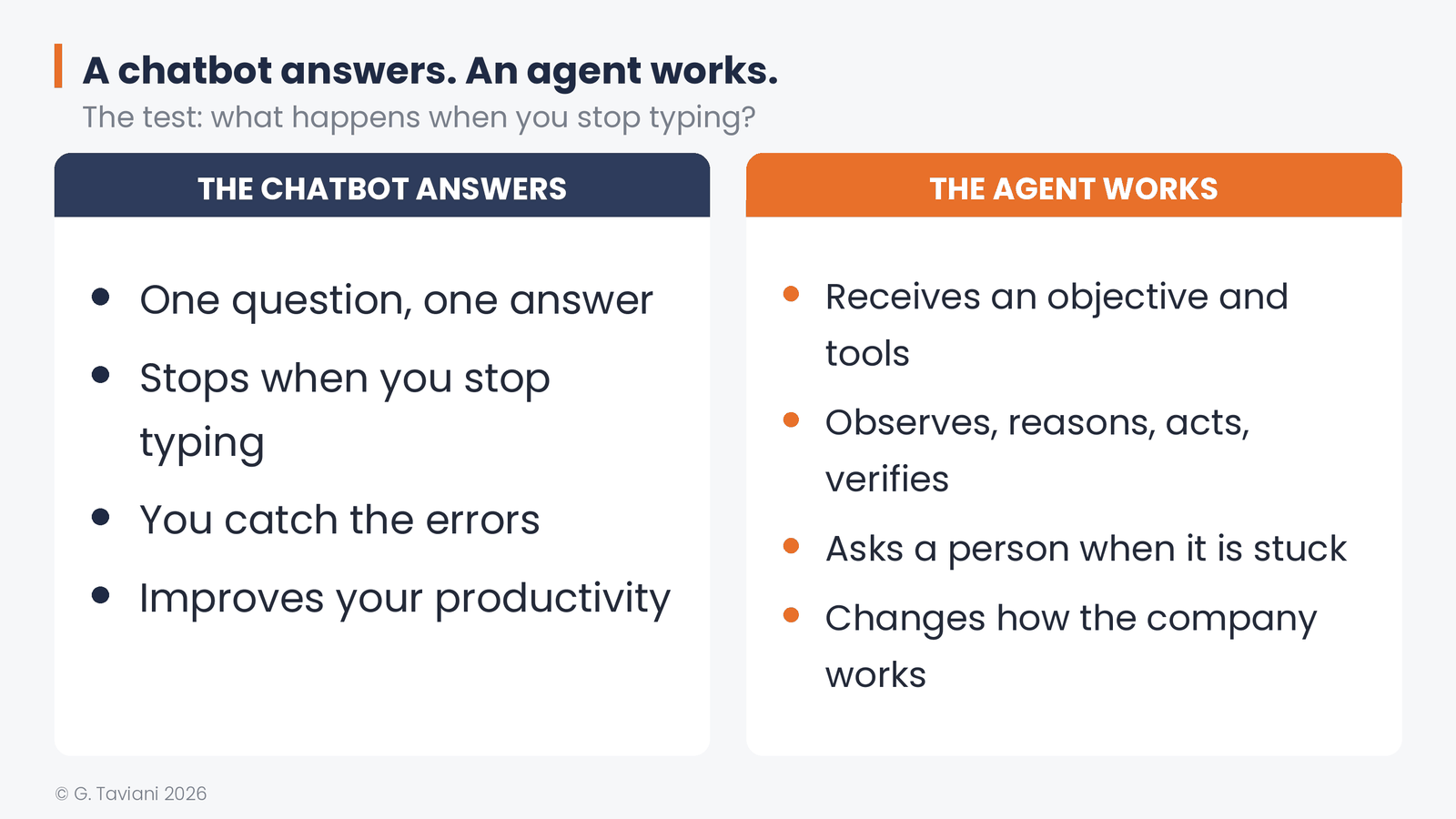
Many suppliers call "agent" what is a chatbot with a few connections. Gartner counted only about 130 genuinely "agentic" vendors among the thousands claiming the label, and named the phenomenon: agent washing. The test I use with clients is simple, and it works for you when you listen to a salesperson: if the system stops when the user stops typing, it is a chatbot. If it keeps working toward an objective, checking its own results, it is an agent.
Watch out. "We already have AI in the company" is the sentence I hear most often, and in nine cases out of ten it means "we have subscriptions to a conversational assistant." It is not a criticism; it is a diagnosis. That is not the AI this book is about.
The agent as a digital resource
A change of perspective
The most useful way for a CEO to think about an agent is not "a piece of software." It is "a resource." Software is bought, installed and used. A resource is placed in an organization: it has a role, a scope, a manager, objectives, a cost and a performance review. Everything you know how to do with people — hire, set objectives, measure, correct, promote, stop — applies to agents, with one fundamental difference: the agent works twenty-four hours a day, does not get tired, does not forget procedures, and costs per work done.
This change of perspective has a practical consequence: the decision about an agent is not IT's. It belongs to whoever decides about resources — you and your function heads, supported by HR and finance. Chapter 5 goes deeper.
What stays with people
The agent does not replace the organization: it takes over its executional, repetitive part. In the projects I follow, 70-80% of a process's routine tasks move to agents and 20-30% — risks, exceptions, decisions with P&L impact — stay with people, who become supervisors. The model is called "human on the loop": not inside every step, but above the cycle, with the power to stop, correct, approve. It is also what most regulators now ask for under the name of human oversight.
Data point. Only 13% of workers say agents are broadly integrated into their workflows, and only 33% understand how agents function — while 75% believe agents will be vital to their company's success. The gap between belief and practice is where the work is. Source: BCG, AI at Work 2025 (10,600 workers, 11 countries).
From prompt to loop
Why the prompt is not enough
There is a fundamental difference between a system based on prompts and one based on loops, and a CEO must understand it because it is the difference between a reliable result and a random one.
The prompt-based system receives an input and produces an output, once. If the output is wrong, the user notices. If a piece of data is missing, the system tends to invent it. Every answer is a single attempt, and quality depends on how good the question was.
The loop-based system receives an objective with its conditions of success and works until it meets them: it observes, reasons, acts with its tools, compares the result against the conditions, and if the result is not satisfactory it starts again with a different strategy. If it cannot proceed, it stops and asks a person. The difference is not the quality of the model: it is the architecture of the work. The prompt produces answers; the loop produces verified results.
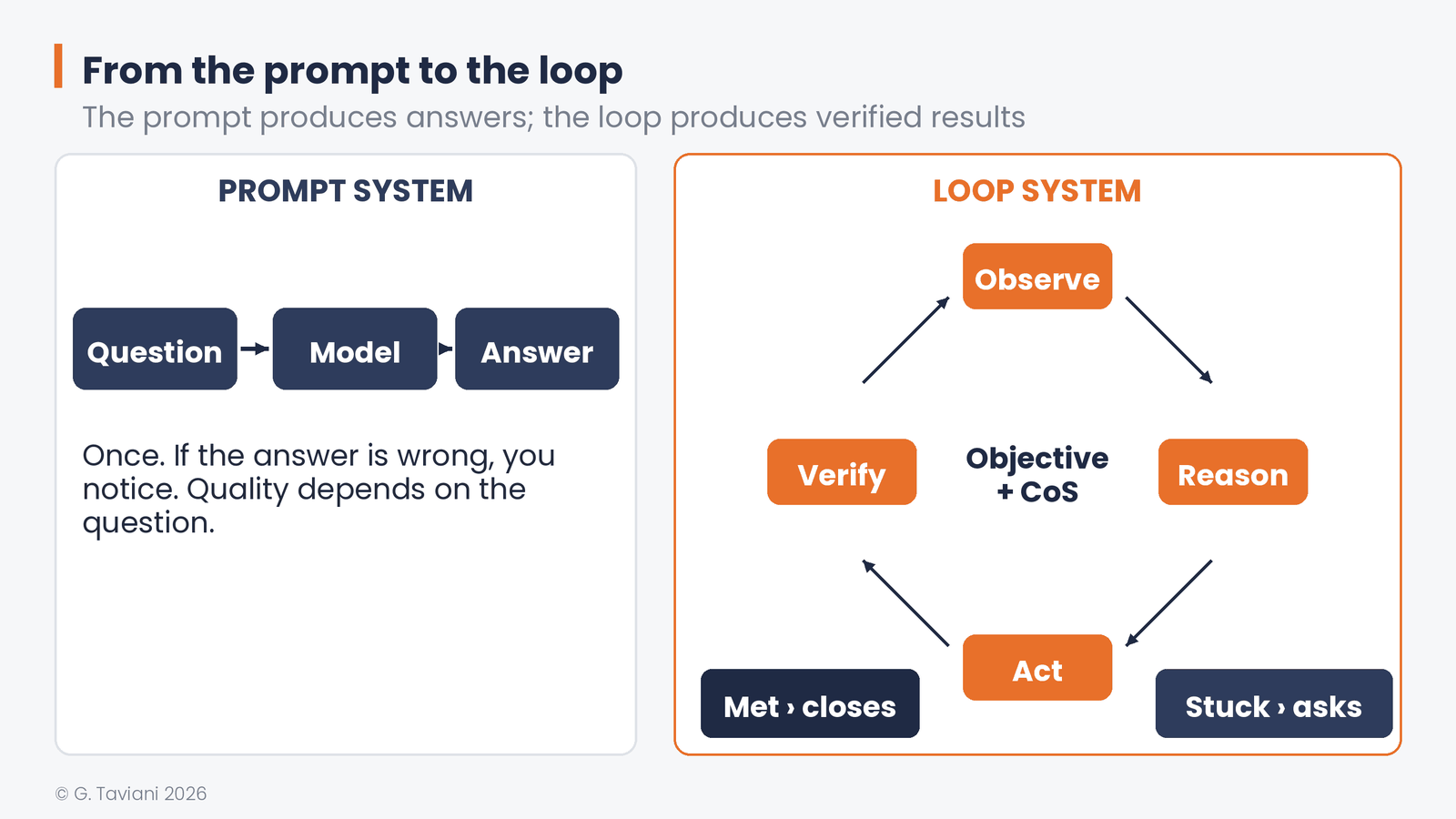
Hallucination — the system stating something false with confidence — is the risk every executive mentions first, and the loop is the most concrete answer. The mechanism is the same you would use with a new hire: you do not trust the first answer, you have it checked against something external — a piece of data, a control, a declared objective — and you have it corrected. Research shows that a system alternating reasoning and verification with external tools cuts false positives by more than half compared to one that answers in a single pass, and that a mid-range model used in a loop outperforms a top-range model used once.
For you this has a precise meaning: an agent's quality depends less on "the most powerful model" than on how its work is structured — objective, conditions of success, checks, the point where it stops and asks. That way of structuring work is the subject of chapter 3.
The residual risk and how it is governed
A looping agent has a risk of its own: insisting forever, or quietly softening its constraints in order to declare itself "done." It is governed with structure, not trust: a maximum number of attempts, after which the agent declares a breakdown and asks a person; a register of the agreed conditions that the agent cannot modify on its own; a spending cap that blocks the work before costs escape. When a consultant presents you an agent, these three things must be in the design. If they are not, it is not a design: it is a demo.
The AI Team: orchestrating agents
From one agent to a team
Placing a single agent does not change the organization: it changes a process. Placing an AI Team — a group of coordinated agents with roles, objectives and a "lead" that reports to a person — changes the org chart.
An AI Team is organized like a department. There is a coordinating agent (I call it the chief) that receives objectives from the human manager, breaks them into tasks, assigns them to executing agents, verifies their results and reports back. There are specialized agents, each with its own skills and tools: one reads orders, one answers customers, one prepares reports, one checks prices. And there is a working protocol between them: who asks what of whom, under what conditions, who verifies.
The typical structure I design for an online retailer has a Chief E-Commerce AI Agent coordinating three or four sub-teams — revenue, customer experience, retention, optimization — each with specialized agents. In a manufacturer the teams are different, but the logic is the same: an org chart, not a list of automations.
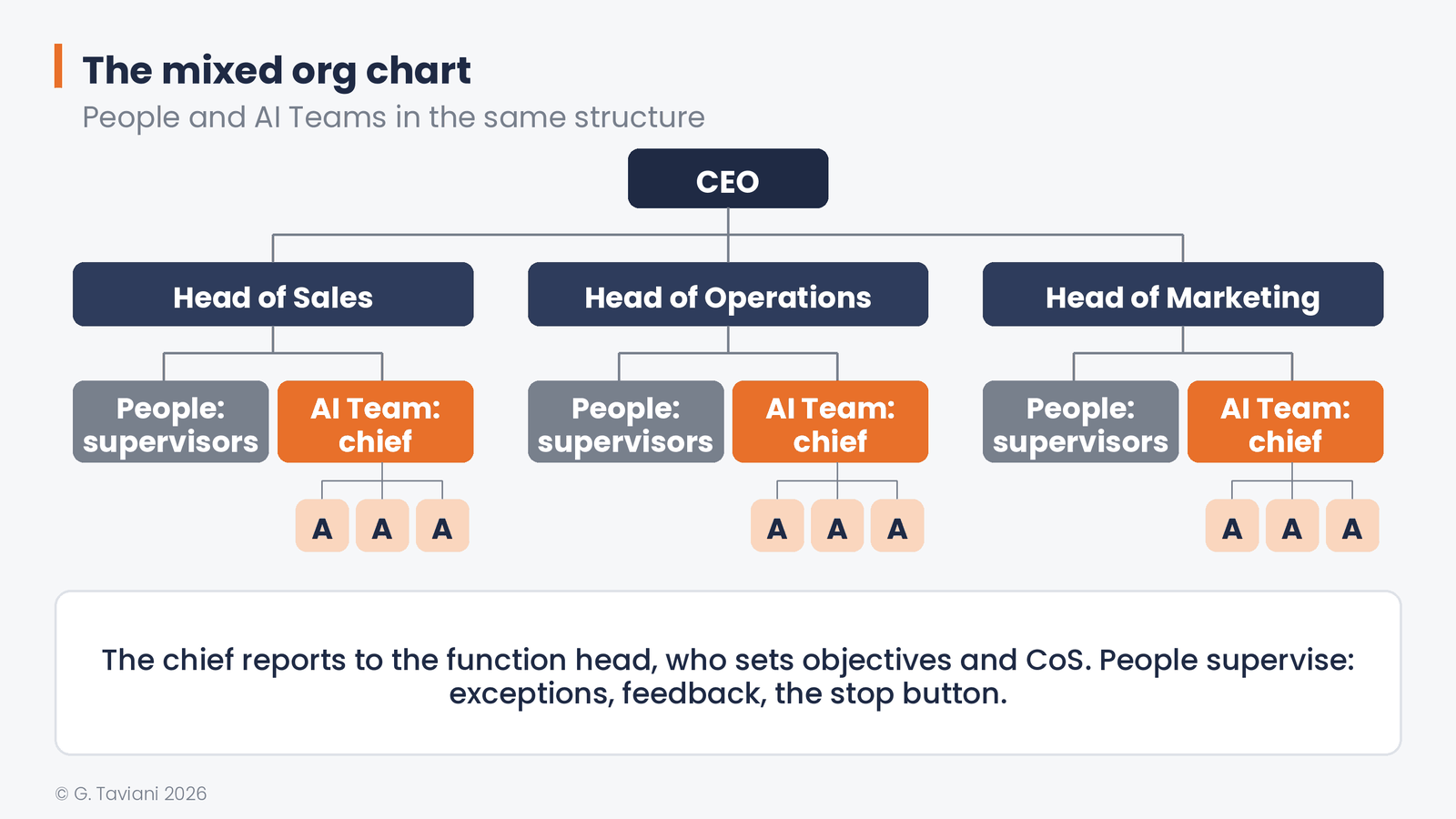
An AI Team without people does not exist, and the human roles must be defined before the agents. In the projects I follow there are three.
The function head is the team's "customer": defines objectives with their conditions of success, approves decisions above thresholds, reads the dashboard. It is not a technical role: it is the sales director, the head of operations, the CFO.
The operational supervisor is the person who today does the work the team will take over: handles exceptions, gives feedback to the agents, stops them when needed. This is where operational staff are reskilled, and in my projects it carries new titles — AI operations coordinator, analytics and optimization lead — held by people who used to do data entry.
The AI consultant — or, in larger companies, an equivalent internal figure — governs the team as a whole: designs, measures, optimizes cost and skills, proposes the next step. Chapter 8 explains how to choose one.
How the AI Team fits with human teams
The org chart becomes mixed: alongside human functions appear teams of agents with a chief reporting to a human manager. People do not "use" agents the way one uses software: they work with them the way one works with a department. Whoever answered a hundred requests a day becomes whoever supervises the agent that answers, handles exceptions and reads satisfaction trends. The manager who spent 60-70% of the time on routine returns to strategy.
This integration must be designed, not suffered. The projection I usually draw with a client is three years: in the first, 4-6 agents work alongside 6-8 people on one process; in the second, 8-10 agents work with 3-4 people who govern; in the third, 12-15 agents with 2-3 people. It is not a forecast: it is a plan you can accept, slow down or stop at every step, measuring what has changed.
Example. In a fashion e-commerce with twelve people, two customer-care staff answered about 400 requests a week; 80% were about order status, returns and sizes — information already in the ERP. An AI Team of three agents — one for routine requests, one for returns, one for the weekly summary — took over that share in six weeks. The two staff became the team's supervisor and the head of service quality; the freed time (about 25 hours a week) went to assisted selling for high-value customers. (Case anonymized.)
What to take away
A chatbot answers, an agent works: the test is whether it keeps going when the user stops typing. An agent is a resource to be placed in the organization, not software to be installed. Its reliability depends on the structure of the work — objective, conditions, checks, stopping point — more than on the model. And the real change comes with the AI Team, which enters the org chart with human roles defined before the agents.
Your to-do list.
- Next time a supplier offers you "an AI agent," ask three questions: What happens when the user stops typing? How does it verify it reached the objective? What does it do when it cannot? No clear answer to all three means you are being sold a chatbot.
- List the three most repetitive processes in your company: they are candidates for the first agent.
- Sketch your org chart with one AI Team next to one function, with a chief and a human head. Keep it: it is the destination.
Frequently asked questions
What's the actual difference between a chatbot and an AI agent?
A chatbot answers: it receives a message and produces a response, and it stops existing the moment the user stops typing. An agent works: it receives an objective, has tools to reach it, and keeps observing, acting and verifying in a cycle until the goal is met or it hits an obstacle that needs a person. The one-sentence test: if the system stops when the user stops typing, it is a chatbot.
How do I know if my company is using real AI agents or just a chatbot?
Ask what happens when the user stops typing, how the system verifies it reached its objective, and what it does when it cannot. Gartner counted only about 130 genuinely agentic vendors among the thousands claiming the label — the phenomenon has a name, agent washing — so "we already have AI" usually means subscriptions to a conversational assistant, not agents doing the company's work.
Do AI agents hallucinate, or is that only a chatbot problem?
The risk exists for both, but a well-built agent's loop is the concrete answer to it: instead of trusting a single answer, the agent checks its own result against external data or a declared condition and corrects itself, the way you would with a new hire. Research shows that alternating reasoning and verification against external tools cuts false positives by more than half compared to a single-pass answer, and a mid-range model used this way outperforms a top-range model used once.
What is an 'AI Team' and how is it different from using several separate AI tools?
A single agent changes a process; an AI Team changes the org chart. It is a group of coordinated agents with defined roles and a "chief" that reports to a human manager — organized like a department, not a list of disconnected automations. Three human roles sit around it: the function head who sets objectives, the operational supervisor who handles exceptions, and the AI consultant who governs the team as a whole.
Sources
- Anthropic, Building Effective Agents, December 2024.
- Gartner, Gartner Predicts Over 40% of Agentic AI Projects Will Be Canceled by End of 2027, June 2025.
- BCG, AI at Work 2025: Momentum Builds, but Gaps Remain, June 2025.
- Microsoft, 2026 Work Trend Index: Agents, human agency, and the opportunity for every organization, May 2026.
- Yao S. et al., ReAct: Synergizing Reasoning and Acting in Language Models, ICLR 2023.
- DeepLearning.AI, Andrew Ng, How Agents Can Improve LLM Performance, March 2024.
- IBM Think, What Is Loop Engineering?, 2026.
- Agent Skills, An open standard for agent skills, 2025.
- Gabriele Taviani, AI Team: what it is and how it really works, GTAVIANI blog, 2026.
Comments & reviews
No comments yet.
Log in to leave a comment or review.