9. Nations, Power, and the AI Infrastructure Race
Every CEO who lived through the year 2000 has the right to a suspicion: is this a bubble? This chapter answers with the numbers, but it goes further, because the most important thing about the AI wave is not how much companies are spending. It is that governments are treating AI the way they once treated energy and telecommunications: as infrastructure of power. Understanding why tells you what the rules will look like (chapters 10 and 11) and where the money, the incentives and the constraints for a company like yours will come from.
By the end of this chapter you will know four things: who is spending what, why governments fear AI as much as they want it, what they expect in return, and — the part that concerns you most directly — why the SME is the actual target of their policy.
Why governments treat compute like energy
The three meanings of sovereignty
"Sovereign AI" has become a slogan, and like every slogan it hides three different objectives. Supply security: securing compute, power and models on acceptable terms, so that a country's economy does not stop if a foreign supplier changes its terms. Legal authority: keeping data and decisions under domestic law, not foreign courts. Value capture: having domestic companies earn lasting margins in the AI stack, not just rent it.
Most countries are pursuing the first two and struggling with the third. The single biggest bottleneck, according to every analysis, is not chips: it is power and grid connection. A data center is a power plant's customer before it is a computer.
Five national models
Countries are following five recognizable strategies. The dealmaker (France, the Gulf states) leverages energy and land to attract foreign capital. The procurer (South Korea, Japan) buys compute at state speed: Seoul secured 10,000 GPUs in a year. The subsidizer (the EU, India) funds compute and factories so that domestic firms can use them. The governor (Singapore, the UK) offers regulatory certainty and fast permits as the attraction. And the dependent — most countries — buys "sovereign" cloud regions from the same hyperscalers, which improves legal authority but leaves supply hostage to a vendor's roadmap.
None of this is a fashion. When competing governments spend on the same infrastructure with the same urgency, the technology has stopped being optional.
The money on the table
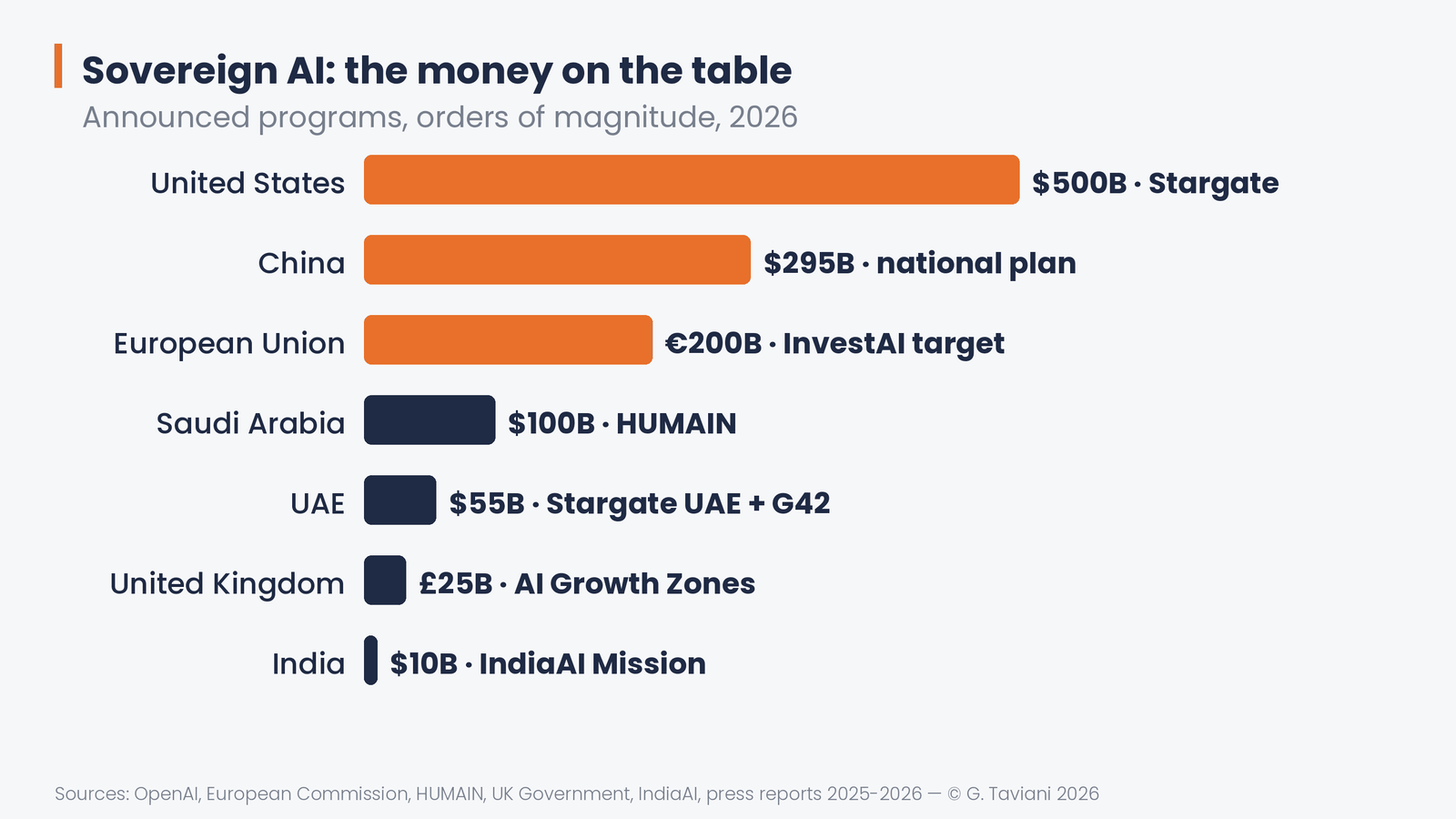
Two things stand out. First, the private figure dwarfs any single public one: the four largest cloud providers alone are spending more in 2026 than any government program. Second, the public figures are not symbolic — Qatar's data-center plan is 9% of its GDP; South Korea is deploying 5.7% of GDP over five years.
Data point. Worldwide AI spending is forecast at $2.67 trillion in 2026, up 49.5%, and $5.95 trillion by 2030. In 2000 the companies of the bubble sold promises; today AI suppliers bill consumption, and consumption grows because customers use it. This does not exclude stock-market corrections or the failure of individual players — there will be both — but the infrastructure, like railways and fiber, stays and gets cheaper for whoever uses it. Source: Gartner, Forecast: AI Spending, Worldwide, July 2026.
Why governments fear AI
The same governments that are spending hundreds of billions are also the ones writing the strictest rules. The two facts are not in contradiction: they are two faces of the same judgment — that AI is powerful enough to destabilize.
Information and elections. The World Economic Forum's Global Risks Report 2026 ranks misinformation and disinformation as the second most severe global risk over two years and the fourth over ten. AI-generated content — cheap, convincing, scalable — is the accelerant. Every democracy has an election coming, and every government knows that the cost of manipulating public opinion has collapsed.
Employment and social stability. The IMF estimates that AI will affect almost 40% of jobs worldwide, 60% in advanced economies, with about half of those exposed negatively, and that it is likely to worsen inequality. The WEF projects 92 million jobs displaced and 170 million created by 2030 — a net gain, but not for the same people, in the same places, at the same time. Governments are not afraid of the net figure. They are afraid of the transition.
Concentration of power. A handful of companies own the frontier models, the chips and the largest data centers. For a government, depending on them for the economy's core infrastructure is a strategic vulnerability of the same kind as depending on a single supplier for energy. This is what "sovereignty" means in practice, and it is why 83% of CEOs in IBM's 2026 survey call AI sovereignty essential to their strategy, and why 77% of companies in Deloitte's survey now factor a vendor's country of origin into their choice.
Loss of control. The frontier models of 2026 are the first to be rated "critical" for cybersecurity risk by their own makers. Long-term, the WEF ranks "adverse outcomes of AI" fifth among global risks — up twenty-five places from its two-year ranking. Regulators are writing rules for a capability that is running ahead of the controls.
What they expect in return
Governments are making a bet with a timing problem. Moody's projects that AI could add about 1.5% a year to GDP across 106 countries — but the infrastructure costs come years before the productivity gains, and a country "might have to choose between taking on more short-term debt risk or missing out on future AI-driven growth." The expected returns are four: productivity and growth; national champions that capture value instead of renting it; independence from foreign suppliers; and defense capability.
The condition attached to every one of those returns is the same, and it is the sentence a CEO should underline: the productivity payoff "depends on widespread adoption." A country that builds gigafactories and whose companies keep working the way they did in 2022 has bought power plants for factories that do not exist.
Watch out. The fiscal bet is real, and so is its downside. Governments that spend heavily on AI infrastructure need tax revenue from AI-driven growth to pay for it; if adoption is slower than planned, the debt stays and the growth does not come. The US Congressional Budget Office calls AI's fiscal impact "highly uncertain." For a company, this means incentives today and, possibly, new taxes or levies tomorrow. Plan for both.
The SME is the policy target
Here is the part that concerns you most directly, and the one policy documents say least loudly.
The adoption gap is the policy problem
Large companies are already adopting. The gap is below them. In the EU, 55% of large enterprises use AI, but only 30% of medium and 17% of small ones. In the United States, 37% of firms with 250 or more employees use AI, against under 20% of those with fewer than twenty — and the small-firm figure has been flat while the large-firm figure rises. The OECD's own assessment is blunt: SME adoption "remains relatively low compared to other digital technologies and to larger firms," held back by four missing enablers — connectivity, data and compute, skills, and finance.
The GDP promise cannot be kept without you
In every OECD economy, SMEs are the majority of employment and a large share of output. If AI raises productivity only in large firms, the national numbers barely move, and the fiscal bet fails. This is why even China's top-down AI Plus blueprint concedes that diffusion "may struggle" among smaller firms, and why the OECD recommends differentiated support by firm size and digital maturity. The gigafactories are being built for you, whether the press releases say so or not.
What flows to SMEs — and what constrains them
The practical consequence is a set of instruments a CEO should know exist:
| Instrument | Examples | What it means for you |
|---|---|---|
| Subsidized compute | India's empaneled providers; EU AI Factories open to SMEs | Cheaper access to models and processing than buying from a hyperscaler |
| Regulatory sandboxes | EU (from 2027), UK Growth Lab, India, Singapore | A place to test an agent with regulators watching, without full compliance cost |
| Public procurement standards | Switzerland, Japan, US federal guidance | If you sell to government, the national AI framework becomes your specification |
| Incentives and vouchers | National digital-transition programs in most OECD countries | Direct co-funding of consulting and adoption |
| Sovereign cloud offers | Every hyperscaler, plus national providers | Data stays in-country; sometimes required, sometimes just preferred |
| Data localization and "buy sovereign" preferences | China, increasingly the EU and Gulf | A constraint on which models and clouds you can use for which data |
The instruments are not evenly distributed and they change yearly; chapters 10 and 11 give the country detail. What does not change is the direction: governments need your company to adopt, and they will keep paying for part of it while they also regulate it.
Example. A regional food producer with ninety employees applied for a national digital-transition voucher that co-funded 50% of its first AI consulting engagement, and ran its first two agents on a national AI Factory's subsidized compute rather than a commercial cloud. The consulting cost was halved and the consumption cost in year one was a third of the commercial quote. The condition was that the company's data stayed in-country — which its largest customer, a public buyer, was about to require anyway. (Case anonymized.)
What this means for the CEO
Four conclusions. The infrastructure is real and will get cheaper for you: a price correction in the AI market is good news for a user. The rules are strict because the stakes are political, not because regulators dislike business: read them as the price of the money on the table. Sovereignty is now a business variable: which country's models and clouds you use will be asked by customers, buyers and, in some markets, the law. And you are the target: the incentives exist because governments need SMEs to adopt — use them while they last, and design for the constraints that come with them.
Your to-do list.
- Ask your consultant or your industry association for the list of AI-adoption incentives, sandboxes and subsidized compute available in your country this year.
- Check one thing on every AI supplier you use: in which country is your data processed, and under whose law.
- Decide whether sovereignty is a variable for your customers; if it is, write it into the supplier clauses of chapter 12.
Frequently asked questions
Why are governments spending hundreds of billions of dollars on AI infrastructure?
Because they are treating compute the way they once treated energy and telecommunications — as infrastructure of national power, not a passing trend. Governments are pursuing supply security (guaranteed access to compute and power), legal authority (keeping data under domestic law) and value capture (having domestic firms profit from the AI stack), and the single biggest bottleneck behind all of it is power and grid connection, not chips.
What does 'sovereign AI' actually mean for a company like mine?
It bundles three distinct goals your country may be pursuing: securing its own compute and power supply, keeping your data under domestic law rather than a foreign court's, and building domestic companies that profit from AI rather than just renting it. In practice it becomes a business variable for you too — customers, public-sector buyers and increasingly the law itself are starting to ask which country's models and clouds you rely on.
Is this government AI spending going to benefit small businesses, or just big tech?
Small and midsize companies are the actual policy target, even when the press releases do not say so. Large firms already adopt AI at far higher rates than small ones (55% versus 17% within the EU), and since SMEs are the majority of employment in most economies, the productivity gains governments are betting on cannot happen without you — which is why subsidized compute, regulatory sandboxes and adoption vouchers exist specifically to close that gap.
Could all this government AI spending lead to new taxes on my business later?
It is a real possibility worth planning for. Governments need tax revenue from AI-driven growth to justify the infrastructure spending, and if adoption is slower than planned the debt remains while the growth does not arrive — the US Congressional Budget Office itself calls the fiscal impact "highly uncertain." Expect incentives today and, possibly, new taxes or levies tomorrow, and plan for both.
Sources
- RCR Wireless (Analyst Angle), Sovereign AI strategies are converging on bottleneck blueprints, June 2026.
- Presenc AI, Sovereign AI Infrastructure Tracker 2026, May 2026.
- Epoch AI, OpenAI Stargate: where the US sites stand, 2026.
- The AI Insider, EU Launches Tender for Up to Seven AI Gigafactories, July 2026.
- Bloomberg, China Plans $295 Billion Investment to Build Nationwide AI Data Centers, June 2026.
- Trivium China, The AI Plus initiative — China's blueprint for AI diffusion, 2025.
- Yahoo Finance, Hyperscalers Hit $700 Billion in 2026 AI Spending Plans, May 2026.
- Gartner, Forecast: AI Spending, Worldwide — 2Q26 update, July 2026.
- Fortune / Moody's, Countries' AI spending could mean they are taking on bigger debt risks, February 2026.
- World Economic Forum, Global Risks Report 2026, January 2026.
- IMF, AI Will Transform the Global Economy. Let's Make Sure It Benefits Humanity, January 2024.
- World Economic Forum, The Future of Jobs Report 2025, January 2025.
- Eurostat, Use of artificial intelligence in enterprises, December 2025.
- US Census Bureau, Large Firms With at Least 20 Employees Biggest AI Users, May 2026.
- OECD, AI adoption by small and medium-sized enterprises, December 2025.
- IBM Institute for Business Value, CEOs are Reshaping C-suite Roles for the AI Era, May 2026.
- Deloitte, State of AI in the Enterprise 2026, 2026.
Comments & reviews
No comments yet.
Log in to leave a comment or review.